As of December, 2009, this blog is inactive at this location. All posts have been transferred to the new location here. You are very welcome to read and comment.

Monday, June 15, 2009

New Church


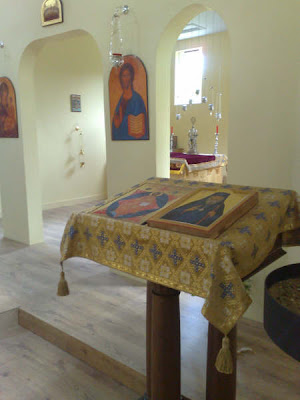
Icons and the altar of the "Joy of All Who Sorrow" parish

The new church of the Mother of God: Joy of All Who Sorrow, in Mettingham, is to be blessed as an Orthodox church by His Eminence Archbishop Mark of Great Britain on Thursday, the 16th of July, in the presence of the relics of the Holy New-Martyrs Elisabeth and Barbara. The church was built in sections in Russia and shipped to the UK for assembly, and is now complete save for the doors of the iconostas. A few photographs may be seen on the gallery linked from the diocesan website. While simple, the building has some notable features, not the least of which are the late Anglo-Saxon/early Norman influence appearance of the arches of the iconostas, along with the lamps which are unusually but beautifully suspended above the Holy Table rather than resting upon it.

It is now the third purpose-built Orthodox church in our diocese and a sign of the restoration of the Orthodox Faith in the British Isles, and has largely come about through the hard work of Father Deacon Andrew Bond, supported by Reader Mark Tattum-Smith and the faithful of the Waveney Valley area. Regular services have been offered in the church now since Pascha.

Unfortunately, I shan't be able to be there, as transportation would be difficult to arrange and this falls two days before my own parish's patronal festival, when we shall move into our new building. Still, I pray that all goes well at this exciting time in the life of this new parish.

God grant them many years!

Sunday, June 14, 2009

Paraklesis


The Hodigitria icon of the Mother of God

My parish plans to do the Paraklesis service for the first time during this upcoming Dormition fast. I have only myself been recently exposed to it and I must say that the words really touch me. There's a difference between reading a prayer and praying it but I have so far found it imposisble to read the words of this without finding myself stirred to prayer.

Does anybody know where I may be able to find the music for it, especially as sung by Abouna's Angels on their splendid CD?

Higher than the heavens above art thou, and thou art much purer than the radiance of the sun, for thou hast redeemed us out of the curse that held us: O Mistress of Creation, thee do we magnify!

From the great abundance of all my sins, ill am I in body, ailing also am I in soul. Thee have I as refuge. Do thou, therefore, O help me, O hope of all the hopeless, for thou art full of grace!

O Lady, and mother of Christ our God, receive supplication from us sinners, who beg of thee that thou make entreaty unto the One born from thee: O Mistress of Creation, pray thou to God for us!

Now we chant with eagerness unto thee with this hymn most joyful, Theotokos, all-lauded one. Together with the Baptist and all the Saints together, beseech, O Theotokos, that we find clemency.

Speechless be the lips of the impious, who refuse to reverence the revered icon, which is known by the name "Directress", and which hath been depicted for us by the Apostle, Luke the Evangelist.

Holy array of angelic hosts, O thou holy Baptist, and ye holy Apostles, all ye Saints together, as well as God's Birth-Giver: pray, make ye intercessions for our deliverance!
The megalynaria from the Paraklesis service, sung after the supplicatory canon

Wednesday, June 10, 2009

Relics of St Elisabeth to visit UK

Initial information is here and details will be published in further updates.

Tuesday, June 02, 2009

St John the Wonderworker - video


Lo, thy care for thy flock in its sojourn hath prefigured the supplications which thou dost ever offer up for the whole world. Thus do we believe, having come to know thy love, O holy hierarch and wonderworker John! Wholly sanctified by God through the ministry of the all-pure Mysteries, and thyself ever strengthened thereby, thou didst hasten unto the suffering, O most gladsome healer. Hasten now also to the aid of us who honour thee with all our heart. - Troparion, tone 5

I am delighted to report that a new video recounting the life of St John the Wonderworker has been released on DVD. As a great lover of this Saint, I thoroughly look forward to receiving my copy. A trailer of the DVD has been posted to Youtube and is here:


Copies of the DVD may be obtained from the Revd Father Peter Shashkoff at StJohnofSF@gmail.com.

St John, as I have posted in the recent past, was a great supporter of the restoration of Orthodoxy to people of western lands, encouraging devotion to the first-millennium Saints of the west, and blessing for use, and himself serving, the Gallican Divine Liturgy of St Germain. He had a love for encouraging the young in the Faith and is reported to have often been late for Divine Liturgy because he would stop to skip and to play other games with young people in the street. I would have loved to see a becassocked archbishop in such a situation.

Among the stories of him that I have heard is one from the days when he took care of my own diocese. He was making a visitation to the parish of St Nicholas, in Bradford, went to the address to which he had been told to report, and was asked to stay on the doorstep while a cup of tea was fetched for him, which he humbly did. It seems that his host was unconvinced that the little man in a tattered cassock was in fact the archbishop, such was his unpretentious appearance and humble manner. Yet it speaks in his host's favour that the Saint was offered hospitality in spite of the doubts over his identity.

I have read his book on the Mother of God, and have two books about him, Man of God, which includes many stories from those who encountered him during his rearthly life, and Lantern of Grace, which contains many high quality photographs of him, including some from the glorifcation services. Both are available from Father Gregory at the St John of Kronstadt Press.

There is a collection of his writings here, and some good photographs here.


St John serving the restored Gallican Mass at the then ROCOR Cathedral of St Irenée in Paris


St John's Feast falls on the 19th of June, being the 2nd of July in the Orthodox Church calendar.

Holy Wonderworker John, pray to God for us!

Friday, May 29, 2009

All that glitters...

I have a great personal devotion to Blessed Seraphim of Platina, and look forward to his official glorification by our synod, (it being my conviction that this will simply be an earthly acknowledgement of something that has already happened in heaven). Having bought the recording of Fr Seraphim's lecture, Living the Orthodox Worldview on CD earlier this year, I have been interested to hear more of him speaking, (having already read some of his books and part of his biography). I was delighted to learn that another lecture, Signs of the Coming of the End of the World, was also available on CD, and even more so when, yesterday, I discovered that it was also available for download.

I have listened to part of it and decided to post some thoughts here. The following is a part of the "question and answer" discussion following the lecture. He is responding to a question from somebody who had been involved in the World Council of Churches, and had shared some of his negative impressions of it as affirming lowest common denominator religion, where we all 'believe in "Christ" in whom we have no common opinion whatsoever'.

This will seem unpolished for a written piece but please remember that it was not originally a prepared presentation. What follows is my transcription of a small portion of what Blessed Seraphim had to say. I was unable to work out the identity of the author of the book on which he comments but that is not of direct relevance here.

...a very interesting man - although he was a little crazy in some ways - but he had in his last few years became very changed. In fact, he said he felt very strange going to church because he felt that the age of the catacombs was about to come back and that we should go underground to go to church. But he, under the impulse of the last year or two of his life, he wrote a book called Three Conversations on Antichrist and the End of the World, which he sets more like a novel on the coming of Antichrist, and he bases it in the 21st century: world wars and there's a great man - a leader - arises and first becomes president of Europe and then by acclamation he's made president of the world for life, and then world emperor. And he reunites everyone under the basis of like a Roman empire, and then decides he has to have a religious division so he calls a world ecumenical council in Jerusalem and there he offers to all people all that they ever desired so that they sort of acknowledge him, bow down to him.

And the protestants have a special academy opened to explore the scriptures from all different points of view and all different kinds of biblical criticism. And the Catholics have, like, a papal institute, or something or other. And the Orthodox are offered in Constantinople, Hagia Sofia is restored and is meant to be a museum of all possible Orthodox antiquities where every kind of beautiful thing which Orthodox ever had is on display in the museum. That is to satisfy the Orthodox people. And after everyone is satisfied we then all bow down and worship him.

Of course that means that you are satisfied with external things, you think this sort of external point of view represents your religion. Anyone who is attracted by glittering censers, incense, and beautiful vestments first of all, of course he will fall down before Antichrist.

What I found most interesting is how this ties in with personal recent events. Within the past week I received an e-mail with a link to an online petition. This was a petition to the European Parliament to make Turkey's admission into the EU conditional upon the return of Agia Sofia to the Church.

I did sign it but I must confess that, almost immediately afterwards, I thought, 'but why?' Would it once again be a parish? Because of past and present regimes, there are barely enough Orthodox Christians in the whole of Turkey to fill that one building. What purpose would it serve? Even if it were returned, how would it be maintained? What, really, is our desire to get this church back? I am not saying that it should not happen but I'm just not sure what I think. (Incidentally, after signing, I realised that I did actually link to the very same petition myself some time back, on this very blog, some four years ago.)

Here we are, investing so much effort into petitioning the European Parliament - to which our government has pledged allegiance although many of us view it with great suspicion - to give us back Agia Sofia, for which nobody can see any purpose other than it being a museum, while those efforts could be spent elsewhere, on our prayers, on our salvation, on helping the poor and needy, on examining our consciences, making confession, on visiting the sick and the imprisoned, (on maintaining pointless blogs?). Yet, nearly thirty years ago, Father Seraphim warned us of this, and told us that our faith is not based on the external trappings alone, beneficial and vital though they are. So, by all means sign the petition, but first consider why. Is it because you believe that this could be a sign of the restoration of the Faith to Turkey and a source of encouragement to those who pray and fight for this, or is it because of a misplaced sentimentality for the external beauty of abygone age? Let Father Seraphim's final words in the above quotation be a warning to all of us.


Blessed Seraphim, pray to God for us!

Wednesday, May 27, 2009

Pentecostal assistance required

I have just prayed Vespers for the Feast of the Ascension. As I was about to start, I picked up the Festal Menaion so I would have all of the necessaries to hand, and realised that the Ascension wasn't actually in there. It finally dawned on me that Ascension would be in the Pentecostarion instead because it falls during the Paschal season but I neither have nor can afford it at the moment. Anyway, I was glad to find that my fairly recent investment in a copy of the General Menaion, (a sort of fill-in-the gaps book for when you don't have the proper texts for specific feasts and saints), paid off, as it has commons for feasts of the Lord, so I just used those instead and adapted the text (mid-chant) where it invited me to. That seemed to work well enough. I'm sure God heard my prayer.

However, Pentecost is just around the corner, and the General Menaion does not have commons for feasts of the Holy Spirit. Is anybody able to help me by pointing me in the direction of the texts online? Thank you.

(Alternatively, you could buy me a copy of the Pentecostarion!)

St Kitts & Nevis


The green of the fertile soil, the red bloodshed of slavery, the black of the ethnic heritage, the golden-yellow sunshine, and the stars of of twin-island nation where I grew up.

I love this:


Here's the national anthem that we sang in assembly almost every day at school.

Perhaps I'll return one day and plant a small Orthodox mission. Who knows? My tan does need a top-up.

Memory Eternal!

With the Saints, give rest, O Christ, to the souls of thy servants, where there is neither sickness nor sorrow, but life everlasting. Thou alone art immortal, Who didst create and fashion man; but we mortals were formed of earth, and unto earth shall we return, as Thou Who madest me didst command and say unto me; For earth thou art and unto earth shalt thou return, whither all we mortals are going, making as a funeral dirge the song: Alleluia! Alleluia! Alleluia!

My mother's anniversary falls on the 13th of June. Some of you who used to know this blog when it was the Sarisburium blog, may remember my posts a couple of years ago, when I learnt that her death had in fact been suicide. Because she was cremated and her ashes were sprinkled, there is no place that I can visit so I began the tradition in my Anglican days of marking my mother's anniversary each year with a requiem mass. However, this has become an even more poignant time of year for me now that I know the truth behind the scene that I found all those years ago as a child. Many questions have been resolved but many more difficulties have surfaced. My friends and my fellow Christians have been a great help.

The discovery led me, at the end of 2007, to search for my father, whom I had never met as he had left when he learnt that my mother was pregnant. Due to the wonders of Facebook combined with an unusual surname, it took no more than a fortnight for me to track down relatives. While I have gained a brother, and aunts and uncles as a result of this, I learnt that my father had died only months earlier.

On my mother's anniversary, I plan to offer a private reader-service pannykhida in memory of them both. While I know that it will be a week after the soul sabbath, and many of you will already have had your loved ones commemorated then, I would be happy to add to my list the names of anybody else for whom you wish prayers to be offered.

Please would you also pray for me? These discoveries are still quite recent for me and I still carry a fair amount of baggage. June is a difficult time as a result. Thank you.

Just add any names in a comment on this post and I shall remember them.

O God of spirits and of all flesh, Who hast trampled down death and overthrown the devil, and given life to thy world: do Thou Thyself, O Lord, give rest to the souls of thy departed servant, Patrick, and handmaid, Stella, in a place of light, a place of green pasture, a place of repose, whence all sickness, sorrow, and sighing are fled away. Pardon every sin committed by them in word, deed, or thought, in that Thou art a good God, and the Lover of mankind; for there is no man that liveth and sinneth not, for Thou alone art without sin, thy righteousness is an everlasting righteousness, and thy word is Truth. For Thou art the resurrection, and the life, and the repose of thy departed servant, Patrick, and handmaid, Stella, O Christ our God, and unto Thee do we send up glory, together with thine unoriginate Father, and thy most holy and good and life-creating Spirit, now and ever, and unto the ages of ages. Amen.

Tuesday, May 26, 2009

From East to West: part three

Not my own effort this time but here is a comparison done by Father Deacon Benjamin over at his blog.

Monday, May 25, 2009

A Taste of Alexandria

The epiklesis from the Divine Liturgy of St Mark.

========================================

The people sing the following prayers slowly and peacefully while the priest and deacon continue in a low voice.


People: We believe, and glorify the Body and Blood of our Lord and God and Saviour Jesus Christ: fill our hearts with joy and gladness.

Spare us, O Lord our God. (Thrice).

According to Thy great mercy. (Thrice).

And not according to our sins.

Priest: (in a low voice) Thine own of Thine own gifts we have set before Thee, and we pray and beseech Thee, O good God and Lover of mankind: send down from Thy holy height, from Thine appointed habitation, from Thy bosom beyond human experiment, the Comforter, the Spirit of Truth, the Holy One, the Lord and Giver of life, Who spake in the Law and by the Prophets and the Apostles; Who is everywhere present and filleth all things, working sanctification of His own free will, and not as a minister, upon those He chooseth by His good pleasure: One in essence, manifold in His energies, fountain of Divine gifts: consubstantial with Thee, proceeding from Thee, sharing the throne of Thy kingdom and of Thine only-begotten Son, our Lord and God and Saviour Jesus Christ.

Look down upon us, and upon this Bread,

Deacon:
Amen.

Priest: And upon this Cup,

Deacon: Amen.

Priest: And send down Thy Holy Spirit, that He may bless and hallow them, and may act, as God almighty,

Deacon: Amen.

Priest: As the true God of faith.

Deacon: Amen.

Priest: And make this + Bread the Body,

Deacon: Amen.

Priest: And this + Cup the Blood of the New Testament,

Deacon: Amen.

Priest: Of our very Lord and God and Saviour and universal King, Jesus Christ.

Deacon: Amen.

The priest and people immediately make a full prostration. On Sundays and at other times when prostrations are not made in honour of the Resurrection, a deep bow is made from the waist in its stead.

Deacon: Come down, ye Deacons; pray, ye Presbyters.

Exclamation:

Priest: That they may be to all of us who participate in Them for faith, for sobriety, for healing, for temperance, for sanctification, for renovation of soul, body and spirit; for participation in blessedness of eternal life and incorruption, for the glorification of Thy holy name, for the remission of sins; so that in this as in all places Thy most holy name may be glorified, hymned, and hallowed, with Jesus Christ and the Holy Spirit, now and ever and unto ages of ages.

People: Amen. As it was, and is, and shall be, unto generation and generation, and for all ages of ages. Amen.

The Old Rite - part two


Christ Pantokrator in the Old Rite Church of the Nativity, Erie

In this second post about the Old Rite, I want to share some of the treasures that I have found, some of which I have incoporated into my own devotions. I should add that I'm not sure I could belong to an Old Rite parish, as there seems to be a degree of strictness in the execution of the services and prayers that I find too regimented for my own spiritual growth. I also think that there were some traditions that did need to be revised, such as the praying of the third, sixth, and ninth hours in sequential order before the Liturgy instead of at their appropriate times. What I do like, though, is that, when there is no Liturgy, the ninth hour has portions of the Liturgy inserted and becomes a form of what is more commonly known as the Typika service.

However, there are also many beautiful traditions, and I actually have a great deal of sympathy with those faithful people who, three hundred years ago, having been formed from birth in their faith and spiritual life by these prayers and services, resisted when they were suddenly told that they would have to stop using them in favour of abbreviated versions. I think that those of us who belong to the New Rite really have lost something in not continuing some of these devotions.


The Old Rite bilingual prayer book

Perhaps the most obvious difference lies in the music. The Old Rite maintains the use of Russian chant before it was unfluenced by the west, so it is much closer to Byzantine and even Gregorian chant than the four-part harmonies that many of us know today. Znamenny chant, in particular, can be very beautiful, and some good examples of it can be heard sung by the choir of the Valaam monastery on their various recordings, and I am pleased that there seems to be increasing interest in its use in New Rite churches. One noticeable feature is that the voices in this style of chant are what we in the west would call "untrained", producing a very nasal sound. However, this is authentic to this style of music. The Old Rite chants for the readings are nice but they are quite sombre. I have taken to using them during fasting periods and at funerals outside of the paschal season. (Otherwise, I use the melodic chants from the Carpatho-Rusyn tradition). Compare the almost monotone deacon's petitions during the litanies in the New Rite to the beautiful melodies used in the petitions in this video from the Old Rite Uspenia monastery, (it is perhaps best not to comment on the doctrinally-questionable icon in the ceiling):


Some interesting differences that I have noticed is that some things that are optional today seem to be just part and parcel of the Liturgy: the tropars on the Beatitudes, psalm 33, and I'm sure there are others. Perhaps this reflects our modern-day penchant for abbreviating. Some of the litanies, hymns, and responses are slightly different as well - usually longer than what we have today.

Another difference is the manner of crossing oneself. We New Ritualists are accustomed to pressing our thumb and first two fingers together, with our ring and little fingers pressed to our palm, and crossing ourselves at each invocation of the Holy Trinity. In the Old Rite, they cross themselves in the way depicted still in most icons where a blessing is imparted. The first two fingers are extended, with the middle finger slightly bent, and the Cross is seen as a symbol of the Christ rather than the Trinity. This is reflected in when the Cross is made during services and prayers.


The lestovka, in common use in Russia before the importation of the chotki from Greece, is still the most common form of prayer aid used by Old Rite Orthodox Christians.

One thing that I have personally adopted is the use of the entrance and departure bows when entering and leaving church. These exist in the New Rite as well, and the Jordanville Prayer Book does give the manner of doing them, but this form is greatly curtailed and, as such, these signs of reverence are often ignored completelely, especially in churches outside of the Rusian tradition. The journey to church can be quite hectic for me and I find it very helpful to walk into church and have these prayers to say before I venerate the icons and greet my brothers and sisters. It helps me to make the transition from the hustle and bustle of public transport to a quiet reverence, and the departure bows help me to retain that as I leave to go back into the world.

There are many, many other differences in the forms of worship and execution of the services, many of which may be read about here, (though not without bias). There are a good few websites out there with a wealth of information on the Old Rite. However, if some of these seem acerbic in tone, please remember the persecution that Old Rituatlists have suffered at the hands of New Rite church authorities in the past. I have found it better to find people on the internet and approach them directly. I have found them loving and always willing to explain things to me. Better yetm if you have an Old Rite church near you, (which I don't), why not go and visit?

Cross Processions

A quickie. Is anybody able to help with my questions here? Thank you.

Sunday, May 24, 2009

The Old Rite - part one

I have recently developed something of an interest in the Old Rite. I find it absolutely fascinating, although I do have mixed feelings about it. However, all in all, I am delighted that it is an ongoing part of the life of the Church.

Some of you will be aware of the differences today between Russian and Greek practice. Russian churches tend to do the three antiphons in full while Greek churches usually replace them as standard practice with the much shorter form of a few verses from the psalms interspersed between responses - a form that is properly only used on feasts of the Lord. Russian churches do the epiklesis in full while Greek churches do a much, much shorter form, (the longer form did appear in some earlier Greek manuscripts but has fallen into disuse there now). Ask Greek clergy about the Litany for the Departed at the Liturgy and you will be greeted with blank stares. The Litany for the Catechumens is often omitted, as indeed are most of the litanies between the Gospel and the Cherubikon. When the Augmented Litany is used in Greek churches, it is seldom augmented - the reason it is called the augmented litany is that this is when special petitions are supposed to be inserted for local concerns: the sick and departed of the parish, travellers, expectant mothers, the newly-baptised, and so forth - these are not added in most Greek churches. I have also neither heard Psalm 33 chanted in its place in Greek tradition churches nor have I seen it in the Greek service books.

These omissions and abbreviations in the Greek church, (and other churches that follow the Greek tradition), are much maligned by the Russian clergy - and rightly so, in my opinion. How can we stand there during the cherubikon, singing, 'let us now lay aside all earthly cares, for we are about to receive the King of all', while simultaneously omitting half of the Liturgy so that we can get home to the Sunday roast or the football match on the telly? It obviously makes sense to some people but I am afraid that my little mind simply cannot comprehend it. The Saints before us entered as fully as they could into the prayer of the Church and it seems to have done them no harm.

But continue thou in those things which thou hast learned, and which have been committed to thee: knowing of whom thou hast learned them.
2 Timothy 3:14

Many - though not all - of these differences are due to a new Greek typikon which was introduced in 1888. It was the revision work of one man rather than a conciliar effort of liturgical scholars and hierarchs of the Church. Yet, it was blessed for use by the Ecumenical Patriarchate and is today most widespread in the Greek parochial (though not the monastic) tradition, although it is still objected to by many Greek clergy, including Metropolitan Kallistos of Diokleia, who has described the changes as "ill-advised" and the new typikon as being "flawed in many places". I should emphasise at this point that my criticism is not of Greek-tradition clergy. They are simply being obedient to the customs that they have been taught and I am sure serve these forms of the services faithfully. It is the customs themselves to which I am objecting.

So why is there such distaste among the Russian-tradition churches for these Greek-tradition practices? The obvious answer is that many of them reflect a will to shorten the services as much as possible. However, I wonder whether there may be something more to it than this. You see, this has happened before, and I suspect that, having before their eyes to this day the lasting effects of the conflict that ensued, the Russian Orthodox people see it as much more prudent to remain faithful to the tradition that they have received, rather than risking stirring up further and unnecessary trouble.

If we were to travel back in time to the 17th century, what we would find would be a situation where the Greek church had simplified and abbreviated its services over time, ridding them of many accretions that clouded the meaning of the services but also of many beneficial elements that aided the participation of the faithful in the Mysteries of the Church. Patriarch Nikon of the Russian church decided that it was time that Russian practice caught up with these changes in Greece. These changes were implemented, and the result is largely what most Orthodox people today are accustomed to experiencing in the churches and regular prayer life - the New Rite. However, these changes did not slip through without considerable oppositon. Some may see a parallel to what happened in the last century in the Roman Catholic church, which would perhaps have done well to learn from the past mistakes of its Orthodox friends. To cut a long story short, those who opposed the changes were anathematised for their disobedience, and have been treated with alternate sympathy and persecution in the intervening centuries. Today, those who remain faithful to the old rite are called Old Ritualists. Sometimes they are referred to as Old Believers but this has often been used as a pejorative term and many consider it offensive.

There has been a significant amount of hurt caused over the years but the anathemas against the Old Ritualists were finally lifted in the 1970s. A number of Old Rite people have returned to the main Russian church and have been permitted to continue using their earlier forms of prayer and worship, and I pray that the poor treatment that they have received in the past may remain a thing of the past, and that this reunification will continue over the coming years.


Bishop Daniel of Erie, ROCOR Old Rite bishop

In order to better facilitate this, in the Russian Orthodox Church Outside Russia, there has been consecrated an Old Rite bishop to care for an extra-territorial diocese of Old Rite communities, wherever they may be, and one of the most recent episcopal consecrations in our church, that of Bishop John of Caracas, was performed according to the Old Rite.

One of the most prominent Old Rite parishes to have returned to the mainstreasm Russian church is the Church of the Nativity, on whose website there is a fair amount of information about Old Rite practices. I hope to post a little about these practices myself in the near future but, in the meanwhile, please explore this site and learn more about our brothers and sisters who remain faithful to the old ways.

Through the prayers of the Mother of God, may the rapprochement continue!
Please pray

I have just learnt from Aristibule's blog that two of our ROCOR Western Rite priests are currently in hospital. Fr Michael of St Petroc's Monastery in the Australian diocese and Fr David of Holyrood Hermitage in the Eastern American diocese are both battling against cancer. Please pray for God's mercy on them and for the spiritual well-being of those whom they serve during this difficult time.

Pilgrimage to Ireland


O holy hierarch Patrick, wonder­worker equal to the apostles, enlightener of the Irish land: entreat the merciful God, that He grant our souls remission of transgressions! - St Patrick Tropar, Tone 3

I have never been to Ireland but would dearly love to go. My paternal grandmother was Irish and I have recently had a desire to go to visit the area where she would have lived and known, and perhaps explore something of my Irish roots.


St Colman mac Ua Laoighse

My diocese has a small church in Stradbally, dedicated in honour of St Colman of Oughaval. There are some photographs of the church here. It was designed by Father Deacon Andrew Bond of the St George Orthodox Information Service, and built by local crafstmen. While they do not have their own priest, Father Peter from our cathedral travels over to serve the Liturgy for them on a regular basis. I would love to visit this little church and perhaps even do Reader services one Sunday. It would be a great honour.

I have no idea yet when this will be, or whether I shall be alone or take a friend but it is certainly something I wish to do, God willing. I would love to visit some of the shrines and holy places of the Saints of Orthodox Éire. Are there are any particular places that anybody would like to recommend? I'd be grateful for suggestions. Thank you.

Hail, glorious Saint Patrick! dear saint of our Isle,
on us thy poor children bestow a sweet smile;
and now thou art high in the mansions above,
on Erin's green valleys look down in thy love.

On Erin's green valleys, on Erin's green valleys,
on Erin's green valleys look down in thy love.

Hail, glorious Saint Patrick! thy words were once strong
against Satan's wiles and an infidel throng;
not less is thy might where in heaven thou art;
O, come to our aid, in our battle take part.

In the war against sin, in the fight for the Faith,
dear Saint, may thy children resist unto death;
may their strength be in meekness, in penance, their prayer,
their banner the Cross which they glory to bear.

Thy people, now exiles on many a shore,
shall love and revere thee till time be no more;
and the fire thou hast kindled shall ever burn bright,
its warmth undiminished, undying its light.

Ever bless and defend the sweet land of our birth,
where the shamrock still blooms as when thou wert on earth,
and our hearts shall yet burn, wherever we roam,
for God and Saint Patrick, and our native home.