As of December, 2009, this blog is inactive at this location. All posts have been transferred to the new location here. You are very welcome to read and comment.

Friday, September 29, 2006

St Kitts

Wow!

The title of this post links to the homepage of the Anglican churches on the island where I grew up. I had no idea that they had a web presence and I suspect it to be a recent development. In any case, I'm extremely pleased to see it, as it has brought back so many memories. It has been very timely indeed. I explain.

I thank all of you who offered prayers for Stella, the lady whom I mentioned in a post a couple of weeks ago. What I revealed elsewhere but not here was that she was my mother. The very recent revelation about the nature of her death has left me in some degree of shock, upset, anger and bitterness, for all sorts of reasons.

I don't want to go into too much depth about that here, as it is being dealt with privately, but it has left me yearning for more information about what happened, and with a craving for connexions to her life. In the nine years since I moved back to the UK from St Kitts, I have been in touch with folk there only a handful of times. There are various reasons for this, but now I feel a strong need to restore that connexion to my past, and my mother's past. It's a really strange feeling, but it's a positive change and I plan to just go with it and see where it takes me.

Thursday, September 21, 2006

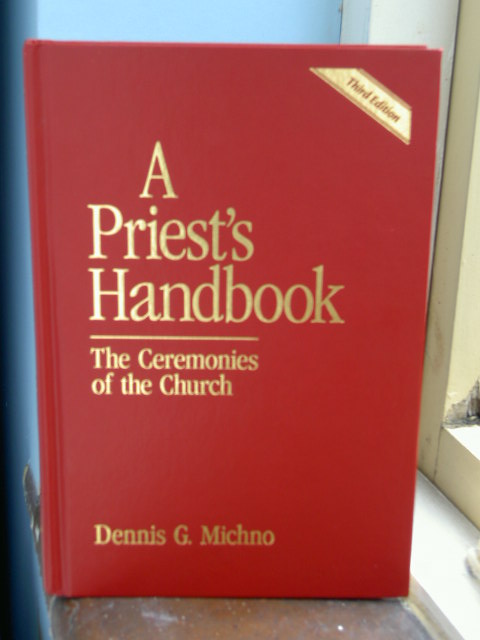
A Priest's Handbook


Just another I thought I'd flag up. There may be one more on its way but I make no promises yet.

By Flowing Waters


And another that I have never used for anything other than occasional reference. The little in it that I persoanlly now have use for is in other publications that I own and so others may have more of a use for this than I do.

The Westminster Missal


This is another shameless plug of an item that I'm currently selling on ebay. I just thought I'd flag it up here in case anybody is interested. The link to the auction is in the title of this post. I've had it for a couple of years now but have hardly had occasion to refer to it and so off it goes.

Tuesday, September 12, 2006

Please pray


The noble Judas exhorted the people to keep themselves free from sin, for they had seen with their own eyes what had happened as the result of the sin of those who had fallen. He also took up a collection, man by man, to the amount of two thousand drachmas of silver, and sent it to Jerusalem to provide for a sin-offering. In doing this he acted very well and honourably, taking account of the resurrection. For if he were not expecting that those who had fallen would rise again, it would have been superfluous and foolish to pray for the dead. But if he was looking to the splendid reward that is laid up for those who fall asleep in godliness, it was a holy and pious thought. Therefore he made atonement for the dead, so that they might be delivered from their sin. - 2 Maccabees 12: 42b-45

Of your charity, please pray for the bounties of the Lord's goodness to be extended to Stella: a strong woman for whom the cares of this life became too much, and who laid violent hands upon herself. May whatever she did as a result of human frailty and weakness be cast into oblivion, for God is a good God and a friend of man.

O God, unto Whom all live, and by whose power our bodies, when they die, are not destroyed, but are in due time transformed into a better estate: we humbly beseech Thee, of thy loving-kindness and mercy, to wash away and pardon whatsoever stain of sin contrary to thy holy will thy handmaid may have contracted, through the fraud of the devil and through her own frailty and iniquity; and that Thou wouldest grant that her soul be carried by the hands of thy holy Angels, and be placed in the bosom of thy Patriarchs, of Abraham thy friend, and of Isaac thine elect, and of Jacob thy beloved, where there is no more sorrow nor sadness nor sighing, where the souls of the faithful rejoice with a happy gladness: and that in the last day of the great judgment Thou wouldest cause her to receive among thy Saints and elect ones a portion in thine everlasting glory, where eye hath not seen, nor ear heard, neither hath it entered into the heart of man to conceive the things which Thou hast prepared for them that love Thee. Through Jesus Christ thine only Son our Lord, Who with Thee and the Holy Ghost, liveth and reigneth, God, now and ever, and unto the ages of ages. Amen.

Sunday, September 10, 2006

The Anaphora of St John Chrysostom

Deacon: Let us stand well; let us stand with fear; let us attend, that we may offer the holy oblation in peace.
People: A mercy of peace: a sacrifice of praise!

Priest: The grace of our Lord Jesus Christ, and the love of God the Father, and the communion of the Holy Spirit be with you all.
People: And with thy spirit.
Priest: Let our hearts be on high.
People: We lift them up unto the Lord.
Priest: Let us give thanks unto the Lord.
Prople: It is meet and right to worship the Father, and the Son and the Holy Spirit: the Trinity, consubstantial and undivided!

Priest (in a low voice, while the people sing the above response): It is meet and right to hymn Thee, to bless Thee, to praise Thee, to give thanks unto Thee, and to worship Thee in every place of thy dominion: for Thou art God ineffable, inconceivable, invisible, incomprehensible, ever-existing and eternally the same, Thou and thine Only-Begotten Son and thy Holy Spirit.

Thou it was Who didst bring us from non-existence into being, and when we had fallen away didst raise us up again, and didst not cease to do all things until Thou hadst brought us back to heaven, and hadst endowed us with thy Kingdom which is to come.

For all these things we give thanks unto Thee, and to thine Only-Begotten Son, and to thy Holy Spirit; for all things of which we know, and of which we know not, and for all the benefits bestowed upon us, both manifest and unseen. And we give thanks unto Thee also for this liturgy which Thou dost vouchsafe to receive at our hands, even though there stand beside Thee thousands of Archangels and ten thousands of Angels, the Cherubim and the Seraphim, six-winged, many-eyed, soaring aloft, borne on their wings, (aloud), singing the triumphal hymn, shouting, crying aloud, and saying:

People: Holy, Holy, Holy, Lord of Sabaoth;
heaven and earth are full of thy glory;
Hosanna in the highest!
Blessed is He that cometh in the Name of the Lord.
Hosanna in the Highest!

Priest (in a low voice, while the people sing the above): With these blessed Powers we also, O Master Who lovest mankind, cry aloud and say: Holy art Thou and all-holy, Thou and thine Only-Begotten Son, and thy Holy Spirit: holy art Thou and all-holy, and magnificent is thy glory: Who hast so loved thy world as to give thine Only-Begotten Son, that all who believe in Him should not perish, but have everlasting life; Who when He had come and had fulfilled all the dispensation for us, in the night in which He was betrayed - or rather, gave himself up for the life of the world - took bread in his holy and pure and blameless hands; and when He had given thanks and blessed it, and hallowed it and broken it, He gave it to his holy Disciples and Apostles, saying:

(aloud) Take, eat: this is my Body which is broken for you, for the remission of sins.
People: Amen.

Priest (in a low voice): Likewise, after supper, He took the cup, saying:

(aloud) Drink, ye all, of this: this is my Blood of the New Testament, which is shed for you and for many, for the remission of sins.
People: Amen.

Priest (in a low voice): Having in remembrance, therefore, this saving commandment and all those things which have come to pass for us: the Cross, the Grave, the Resurrection on the third day, the Ascension into heaven, the Session at the right hand, and the second and glorious Advent, (aloud), thine own of thine own, offering unto Thee, on behalf of all, and for all:
People: we praise Thee, we bless Thee, we give thanks to Thee, O Lord, and we pray unto Thee, O our God. (sung as slowly or as many times as necessary to cover the epiklesis and the memorials).

Priest (in a low voice, while the above is being sung): Again we offer unto Thee this reasonable and unbloody service, and beseech Thee and supplicate Thee...

Priest: O Lord, Who didst send down thy Most-Holy Spirit upon thine Apostles at the third hour: take Him not away from us, O Good One, but renew Him in us who pray unto Thee.
Deacon: Create in me a clean heart, O God, and renew a right spirit within me.
Priest: O Lord, Who didst send down thy Most-Holy Spirit upon thine Apostles at the third hour: take Him not away from us, O Good One, but renew Him in us who pray unto Thee.
Deacon:Cast me not away from thy presence, and take not thy Holy Spirit from me.
Priest: O Lord, Who didst send down thy Most-Holy Spirit upon thine Apostles at the third hour: take Him not away from us, O Good One, but renew Him in us who pray unto Thee.

...send down thy Holy Spirit upon us and upon these Gifts here spread forth...
Deacon: Bless, Master, the holy Bread.
Priest: ...and make this + bread the precious Body of thy Christ.
Deacon: Amen. Bless, Master, the Holy Cup.
Priest: ...and that which is in this + cup, the Precious Blood of thy Christ.
Deacon: Amen. Bless both, Master.
Priest: ...changing + them by thy Holy Spirit.
Deacon: Amen. Amen. Amen.

Priest: (still continuing in a low voice) ...that to those who shall partake thereof they may be unto cleansing of soul, unto the remission of sins, unto the communion of thy Holy Spirit, unto the fulfilment of the Kingdom of Heaven, unto boldness towards Thee, and not unto judgment or unto condemnation.

And again we offer unto Thee this reasonable service for all those who in faith have gone to their rest before us: Patriarchs, Prophets, Apostles, Preachers, Evangelists, Martyrs, Confessors, Ascetics, and every righteous spirit in faith made perfect: (aloud), especially our all-holy, immaculate, exceedingly blessed and glorious Lady, the Mother of God and ever-virgin Mary:
People: It is very meet to bless thee who didst bring forth God: ever-blessed and most pure and the Mother of our God: more honourable than the Cherubim, and beyond compare more glorious than the Seraphim; who without defilement barest God the Word: true Mother of God, we magnify thee!
Priest: (in a low voice, while the above is in singing) ...and for the holy Prophet, Forerunner and Baptist, John; the holy, glorious, and all-laudable Apostles; Saints N. & N., whose memory we celebrate; and all thy Saints, at whose supplications look down upon us, O God. And be mindful of all those who have fallen asleep before us in the hope of Resurrection to life eternal; especially N. & N., and grant unto them rest, O our God, where the light of thy countenance shines upon them.

And again we beseech Thee, be mindful, O Lord, of every bishop of the Orthodox, who rightly dividest the word of thy Truth; of all the Priesthood, the Diaconate in Christ, and of every hieratic and monastic order.

And again we offer unto Thee this reasonable service, for the whole world, for the Holy, Catholic and Apostolic Church, for those who live in chastity and holiness of life, for all civil authorities, and our armed forces; grant them, O Lord, peaceful times, that we, in their tranquility, may lead a calm and peaceful life in all godliness and sanctity.

(aloud) Among the first be mindful, O Lord, of our Great Master and Father Alexei, most-holy Patriarch of Moscow and All Russia; our Master the very most reverend Metropolitan HILARION, First Hierarch of the Russian Church Abroad; and of our Master, the most reverend Archbishop MARK, whom do Thou grant unto thy churches in peace, safety, honour, length of days, and rightly dividing the word of thy Truth.
People (slowly): And all mankind!

Priest (in a low voice, while the above is in singing): Be mindful, O Lord, of this city in which we dwell, and of every city and countryside, and of those who in faith dwell therein. Be mindful, O Lord, of them that travel by sea, land, and by air; of the sick, the suffering, captives and their salvation. Be mindful, O Lord, of them that bear fruit and do good works in thy holy churches, and who remember the poor; and upon us all send forth thy mercies: (aloud) and grant us with one mouth and one heart to glorify and praise thine all-honourable and majestic Name: of the Father, and of the Son, and of the Holy Spirit, now and ever, and unto the ages of ages.
People: Amen!

---------------------------------------------------------

The above is the anaphora from the Liturgy of St John Chrysostom. After having been going to the Liturgy regularly now for nearly a year, I only recently came across the entire text, and was astounded by the sheer beauty of it all. Much of it is said quietly during the Liturgy and so I have only heard the parts that have been sung aloud. I just thought I'd share it here for others who, like me, may be unfamilar with it in its entirety, or indeed, at all.

Enjoy.

Friday, August 11, 2006

Impressions and Memories

Neither judge an apple by its skin
nor a book by the way it's covered;
for inside those tattered pages
there's a lot to be discovered.

Isn't it funny how we form images of what we expect people to be based on the tiniest amount of interaction with or observation of them?

I remember when I was at college, about five years ago now. Every year the college hosted an "Old People's Party". It wasn't a Christmass party or anything like that - just one day, after college hours, we'd put on a spread for some of the elderly people in the area who perhaps didn't get out very much and were perhaps dependent on others a fair bit. We'd put on a spread, sing songs, play bingo and a few board games, and do some other things.

I volunteered to help one year and on the day of the party, I overslept. Having only about five minutes before my bus was due, I just threw on some clothes and legged it to the bus stop. I had my weekly bus ticket in my pocket but realised at college that I had forgotten to pick up my wallet. Not having had breakfast, I was having a lot of difficulty concentrating on anything after lunchtime as I had no money to get lunch and pride prevented me from asking a friend. I was so very hungry!

Anyway, come the end of classes for the day, I went to help prepare for the party. We arranged chairs and tables, and prepared sandwiches. It was really difficult preparing all this food on an empty stomach. All I'd had to eat for the day was a crisp - one solitary crisp - and that's only because someobody I had been speaking with earlier in the day had been eating a packet of crisps and had offered me one.

We made trays of these sandwiches and then took them through to the next room. As I took a tray through, I thought I'd sneak one of the sandwiches to keep me going for a while. Well, as I took the first bite, I became aware of a disembodied voice, saying, 'I thought the sandwiches were for the old people'. I jumped, looked round, and saw, in the doorway, Mrs Whitelegg. Now Mrs Whitelegg was a teacher with whom I had no dealings at all, as she taught a subject I didn't take in a building that I never had cause to enter. She just happened to be walking past the doorway at the time, then she went on her way without saying anything further. I looked in the other direction back into the main hall, and surely enough, Mrs Waller and some of the students who had been arranging the party had heard Mrs Whitelegg and had looked up. When they saw me look back, most of them politely and sensitively looked away and didn't mention it afterwards. I appreciated that but it was all very awkward afterwards and I can still think of very few occasions when I have been so very embarrassed.

Now, I'm sure that Mrs Whitelegg is a lovely lady, with many good qualities and friends who will vouch for that, but the thing is, because of my limited dealings with her, out of my two years at college, my one memory of her was as "that woman who humiliated me that day when I was hungry and had no money to buy food". Now to be fair, I shouldn't have been eating the sandwich, and now I think more about it, the one memory she had of me must have been as "that boy who steals old people's sandwiches".

I suppose it's a lesson not to judge people's personalities based on limited experience of them and that each person is worth getting to know properly. Still, we live in a rational world where much of how we conduct ourselves is based on our experience and it is often difficult to take a step back from that and acknowledge that our experience is not all that there is to the world and to people. Hmmm.

I'm wittering now, so I'll stop.

Monday, August 07, 2006

Saints


All Saints of Britain, pray for us!

The souls of the righteous are in the hand of God,

and no torment will ever touch them.
In the eyes of the foolish they seemed to have died,
and their departure was thought to be a disaster,
and their going from us to be their destruction;
but they are at peace.
For though in the sight of others they were punished,
their hope is full of immortality.
Having been disciplined a little, they will receive great good,
because God tested them and found them worthy of himself;
like gold in the furnace he tried them,
and like a sacrificial burnt-offering he accepted them.
In the time of their visitation they will shine forth,
and will run like sparks through the stubble.
Those who trust in him will understand truth,
and the faithful will abide with him in love,
because grace and mercy are upon his holy ones,
and he watches over his elect. - Wisdom 3: 1-9

There seems to be a gradual increase in the "acceptability" of the veneration of the Saints in the wider Christian world. While I find it upsetting that I even have to phrase it in terms of acceptability, I cannot help but welcome this progression. It is right and proper that the Saints ought to be venerated by all Christians and the Anglo-Catholic movement has done so much in the spread of this basic aspect of Christianity into traditions that perhaps would otherwise not have even considered it.

However, while I see the good in this shift, I cannot help but wonder whether the necessarily apologetic manner in which it has been achieved has not had some unfortunate results as well. Firstly, I do not decry for a moment the efforts of those who have restored this practice to its proper place in the lives of many Christians. This was done often amidst much opposition and so had to presented in many cases as an "optional extra", something that "some people might find helpful".

However, the result is that, the Saints are often presented as examples to follow, good people who found God's favour. Of course, the Saints certainly are those things but it hardly stops there, and traditions that fail to recognise this often treat the Saints as no different from notable historical figures who were also good people. Strange practices begin to occur such as the inclusion of the names of people like Mahatma Gandhi and Chief Seattle in the Litany of the Saints - people whose lives certainly showed something of the love that comes from God but who we can hardly know have attained unto Sainthood. At the same time, people refuse to venerate the Sainted Royal Martyrs of Russia because of negative aspects of their earthly lives. I could understand both practices if Sainthood were merely about having lived an exemplary life but the reality is that this sort of thing betrays a gross misunderstanding of what a Saint actually is in the Christian tradition. The Saints are not merely role models. If that were their purpose, many of them wouldn't be Saints.

What we need to always remember is that the Saints are those who have reached the fullness of God's will for each of us. By God's grace, through the life in Christ in the Church, and through their persistent struggles, they have completed their deification. From the Most Holy, Most Pure, Most Blessed and glorious Lady, theMother of God and ever-virgin Mary to Saint Euphrosynos the Cook, they have nurtured the image of God planted in their hearts from the dawn of their existence and have reached the full realisation of the likeness of God. They fully share in the divine nature, in the energies of God - in his holiness, his knowledge, his wisdom, his love. A proper understanding of this should do away with any sense of having to justify their veneration. It ceases to be merely acceptable and becomes right and proper in the life of the Christian.

Certainly, there will be those Saints whose earthly lives touch us personally more than others due to the depth of the holiness of God that was apparent even in their lives here on earth. There will be those whose lives make us realise so very easily that they, too, were imperfect, as indeed we are. While this is all extremely useful as a pointer to what God would have us be, and the possibility of our reaching that despite our unworthiness, none of this detracts from their present state, which is the reason why we venerate them.

And so we pray to the Saints, we ask for their protection, their guidance, their assistance on our journey of theosis, and we ask for their prayers to God in whose nature they dwell.

All Saints of Britain, pray for us!

Friday, August 04, 2006

Conversion

A number of people over the past few months have asked about my reasons for converting to Orthodoxy, and a few have actually been interested in the detail of my journey. I think that it would be rather a healthy exercise to assess my journey thus far and put my thoughts down in writing, so here we are.

Now, where to start?

I suppose the beginning is as good a place as any. I was born here in the UK, in Manchester, into a predominantly Anglican family that had various degrees of church attachment. My mother died when I was quite young and so I was raised by my very devout grandmother. She is the reason that I am a Christian and I owe so very much to her. We were part of the worshipping community at a middle-of-the-road parish – the sort of place where people speak of “going to church” rather than “going to Mass”. It is your standard, suburban MOTR sort of parish, with wonderful people.

At the age of seven years, I moved with my grandmother back to her home country of St Kitts & Nevis, in the Caribbean. The historical tradition of much of the Anglican Province of the West Indies, and certainly of the Diocese of the North-Eastern Caribbean and Aruba, is Anglo-Catholic. The theological college was founded by the Mirfield brothers, and copies of The English Missal, while now unused, can still be found in many a church sacristy. There were nine parish churches on the island, and the Patronal Festival of each was marked by a Solemn Mass to which at least one minibus-full from each of the other parishes made an appearance. We were taught the Angelus, (which, incidentally, was the name of the diocesan newsletter) and we said the Anima Christi corporately after every Mass. This is the point where I stopped going to church because I had to and started going to Mass because I wanted to. This was after the first year I lived in St Kitts when I went to Mass with my Catholic cousins.

It was in this context that I was formed in Christianity. I was an altar server, ardent Sunday-School-goer, and took myself to about every service that was on (except for the weekday Mass which was on Tuesdays at 6 a.m.). I was surrounded by the awe and mystery of a sacramental community of faith, who sought to become one with God. I was taught a great reverence for the sacraments and my faith continued to grow. I thank God for those years.

In Confirmation class, (yes, we actually had classes where we were taught Christianity and not the informal get-togethers popular nowadays, where people “share their experiences of Jesus”), we explored the Creed and were taught what I came in later years to understand as a development of the so-called “branch theory”. In this version, the “one, holy, catholic and apostolic church” was a collection of various bodies of varying beliefs and practices. Each was a “branch” of the church and, while each branch held different beliefs about even the essentials, they were all part of the church, despite their various errors, because they all sought to follow Christ. This all sounds very nice and sweet, and, as I was nine years old at the time, and as I had no reason to question what I had been told, I didn’t. I was, however, fully aware that this was not the view held by all Christians as I had spent a year with my Catholic cousins. Anyway, more about that later.

I moved back to Britain in 1998 at the age of fifteen, and went back to the church that we had gone to before. I got involved, again as an altar server and chorister, and was elected to the Parochial Church Council. I tried to fit in but the “meat and two veg” religion that exists in middle-of-the-road Anglican churches just seemed devoid of much of what my faith was based on. This was a culture shock to me. In St Kitts, talk of Anglo-Catholicism will get you stared at blankly. It’s a term that doesn’t exist there at all because the concept it refers to doesn’t exist as something separate from "mainstream" Anglicanism, and so they have never needed a word for it. What is known in Britain as Anglo-Catholicism, in St Kitts, is simply Anglicanism. It’s all they’ve ever known and the concept of a middle-of-the-road Anglican church would be very foreign to them indeed. Evangelical Anglicanism would simply be beyond comprehension to them as indeed it was to me for many a year, even after I first came across this phenomenon after my return to the UK.

One thing after another happened that started me looking elsewhere. There was no Good Friday Liturgy, no Easter Vigil, no incense, and no devotions to Our Lady. When I asked for the prayers of “Blessed Mary, the Virgin Mother of God” while leading the intercessions one Sunday, I was approached afterwards by the parish priest to be told that there had been a complaint, so next time I asked for the prayers of “Blessed Mary, the Virgin Queen of Heaven”. When I was approached again, I explained that just as some people found my inclusion of this unacceptable, so I found their omission of it unacceptable, yet I had the courtesy not to make complaints about prayers they obviously put a lot of effort into. (I was an arrogant 16-yr-old so please allow me some leeway). As it happens, nobody commented on my prayers again, except for a few closet spikes who thanked me for them. There wasn’t even a fuss when the thanksgiving for the lives of the departed turned into prayers for the repose of the souls of the departed. It was the custom at this parish to leave the blessed sacrament on the altar after the mass as the aumbry was in the chapel which was some way away (it was a modern building of unique design). After the mass, one of the servers would take the sacrament to the chapel and reserve it. One Sunday, as I was doing this, I followed the custom that I had been brought up with and held the ciborium high, walking with my head bowed. As I was approaching the chapel, two ladies who were chatting saw me, pointed, giggled, and one of them asked, ‘Ooo! What have you got there?’ I said, ‘The Body of Christ’, and went on my way. I look back at this and find it unbelievably rude and self-righteous, and I would never do that today, but as I had been brought up, those ladies should have been on their knees and, at 16 years of age, I was disgusted by their pointing and giggling, which I saw as unashamed irreverence of a sort I wouldn’t have expected in church. The thing is, they obviously saw nothing wrong with it and were genuinely asking what it was.

How could I continue worshipping there?

I began to go to the Saturday evening vigil mass at the local Catholic church in addition to my Sunday mornings at the Anglican church. I went for a few months and became quite involved there as well. I look back and wonder how I did it on Saturday evenings and then all over again on Sunday mornings but I suppose it’s possible when one is in one’s teens. This didn’t prove to be much better. There was certainly more reverence for the sacraments and holy images but the music and liturgy were dire. Still, I approached the parish priest about catechesis, and he put me in touch with the parish deacon. Well, that was fun! We had a few one on one meetings during which he explained the differences between what Anglicans believe and what Catholics believe, and as we went through various topics, time and time again I had to point out that what I was taught as an Anglican bore little resemblance to what he was attributing to Anglicanism and was almost identical to what he was attributing to Catholicism. I’m not entirely sure he ever understood Anglo-Catholicism and must have wondered at this rather eccentric young man who came to see him once per week. Eventually, I got rather fed up of it all and dropped Rome.

At the ecumenical Good Friday service in the civic centre, I mentioned in passing to somebody that I was looking for a church that did an Easter Vigil. It turns out that, while she worshipped at an Evangelical church (because it was nearby and she had toddlers), she had been brought up at a church that does a “cracking Easter Vigil”. I went along and she was right. Four weeks later I went again, and decided that was where I wanted to be. I resigned from the PCC and left, having got utterly and completely fed up. (As an aside, my advice to anybody unhappy with his church is to leave before you become bitter towards it. It really isn’t healthy).

To cut a long story short, I moved about a bit in terms of where I lived but managed to keep my sanity in churches of a decent tradition. During this time, I came across a Christian discussion forum where I spent a fair amount of time and where I first came across Orthodoxy. I had known it existed but that was the extent of my knowledge, as there was no Orthodox presence in St Kitts. I also began to explore a vocation to priesthood. However, due to a number of reasons, that was placed on the back burner. Things were not helped by a member of this forum making malicious use of his knowledge of my real life identity. Anyway, I re-registered on the site under a different name and continued to learn about some elements of Orthodoxy from some of the Orthodox members. I never thought of converting, though.

During this time, I had been a supporter of the ordination of women. Without going into too much depth here into the theology, I saw that a person needed to be human in order to be the image of Christ as a priest and that any further requirement was unnecessary. (At the time, I had not been exposed to the idea of sex as being an intrinsic part of who we are, but I digress). The only objection to the ordination of women that I ever had any sort of sympathy with was the argument from authority. If we, as Anglicans, claimed to be part of the same catholic church as our Catholic and Orthodox brethren, and claimed to have the same Orders, then by what authority could we change them without the consent of the other two major “branches” of the church? I placed these thoughts on the back burner and left them there until a couple of years later, when the furore surrounding the consecration of Gene Robinson, when the same issues were raised yet again.

I began to seriously question all of this. Is Anglicanism right and Catholicism and Orthodoxy wrong? Who says? Where does authority in the Church come from? Where does unity in the Church come from? Indeed, what is the Church?

Well the problems came when I began to find answers. It all began at about November, 2004. Looking at the history of what actually happened in the centuries leading up to the Schism, I arrived at the conclusion that, contrary to what I had been told about Anglicanism and Orthodoxy having much in common because they both split from Catholicism, the reality was that it was quite the other way round, and that it was Rome that had split from Orthodoxy. At the time, this didn’t mean too very much as I still accepted the “branch theory" that I mentioned above, that, despite our differences, we’re one big happy family, honestly. However, even this began to grow less and less convincing as I delved deeper. I looked at the Oecumenical Councils and the various heresies that they dealt with. I looked at how those who had left the Church to follow Arius and Nestorius, among others, had been reconciled with the Church, at the various methods laid down for receiving into the Church people from various heretical sects. I looked at modern Orthodox essays about unity and the Faith and it all seemed to make sense. God is Truth and all we know of the Truth comes from God. Christ prayed that we may all be one and promised us the gift of his Holy Spirit to lead us into all Truth. Therefore, a separation from the Truth does not constitute the formation of a new “branch” within the Church, but rather, it constitutes a separation from the Church. I looked at Scripture and began to realise that what I had been taught about the nature of the Church didn’t seem consonant with what I read in both Scripture and the writings of the Fathers.

At about this time, I got in touch with an Orthodox priest via e-mail and I explained my journey. He was very gentle about the whole affair and wasn’t at all pushy. Having been an Anglican priest himself and having moved for many of the same reasons, I think he understood. (He is now my parish priest). He would e-mail me every now and then to make sure that I was all right and to see how I was getting on, and one of the Orthodox members of the aforementioned Christian forum, who is a local priest, was also a helpful presence for me.

Still, I tried to convince myself of the truth of the branch theory. Of course I did! I had a vested interest in proving it true, as do all Anglicans. My entire life had been outside of Orthodoxy, my formation in the Christian faith had been outside of Orthodoxy, my baptism, my confirmation, my exploration of a vocation to priesthood. My family were all outside of Orthodoxy, my friends, those I knew and loved. These things meant a great deal to me. Surely, this was the reason the branch theory was invented in the first place - as an attempt to justify a situation that was not in keeping with the traditional self-understanding of the nature of the Church. Of course I didn’t want to accept it, but the reality of it is that none of the above made it true – none – and I realised that the sooner I came to terms with it, the healthier it would be for me personally and for my relationships with others.

Having accepted that I was outside the Church, I began to explore the implications of this. Do Sacraments exists outside the Church? Was my baptism a Baptism? Was my confirmation a Confirmation? Had I, in fact, ever received the Eucharist? Was my parish priest even a priest? It got to the point where I was kneeling at the mass on Sundays, not knowing whether what was coming towards me was the Body of Christ or a piece of bread. Do I adore and reverently receive a piece of ice-cream wafer? Do I decline to receive and risk turning my back on my Lord and my God? What was I to do? I was in tears on more than one Sunday.

This is where I began to grow bitter. How dare the Anglican church put me in this situation! I had trusted it. For years, I had been taught by it and had been willing to serve it. Now, suddenly, I realise that what it had taught me over the years was untrue, and I was now left in a position where I was torn in two at the moment which for me, had been the summit of my Christian life Sunday by Sunday. How dare it do this to me! I felt hurt, angry and betrayed. Of course, I knew that the people who taught me what they had actually believed it, and that, logically, I had no reason to be angry. To be fair, I wasn’t angry at any individual but rather at the institution. This soon passed though. The time was ripe for me to leave and this decision was a great step on the healing process because the relief caused by it far outweighed the bitterness, although the anger was to resurge later on for a short time.

Therefore, after many years of moving about and after six months of specifically moving towards Orthodoxy, I left the Anglican church in August, 2005. I was made a catechumen the following month and spent the next few months learning more and more about Orthodoxy and settling into a new way of being. Then I was Baptised, Chrismated, and received the Eucharist for the first time in February of 2006. Blessed be God!

I still hold to the belief that the Sacraments are God’s means of grace within the New Covenant – the Church - and that while He is not incapable of bestowing it howsoever and wheresoever He pleases, it is not our place to claim to know if, where and how He does that. All we can know is what we have in his Covenant with us – the Church. I firmly believe Orthodox ecclesiology as part of the Christian Faith and believe the branch theory and ecumenism based on it to be an ecclesiological heresy. I have no qualms about expressing this where it comes up in discussion in Christian circles. I do not wish to be responsible for furthering the same sort of fallacy that I was subjected to by people who, in turn, had been unwittingly subjected to it themselves and genuinely believed it. I pray for God’s grace on those outside the Church, including my friends and my family, as I trust in the mercy of God, and I take comfort in the verse from the Dies Irae:

Through the sinful woman shriven,
Through the dying thief forgiven,
Thou to me a hope hast given.

Now, I have my own salvation to work out, and that is what I strive and struggle to do, while at the same time trying to raise an awareness of the Church and the need to come to Her for our salvation.

As for other issues, such as the ordination of women and others, I believe the Church to be true for that is Christ’s promise, and I do not have the arrogance to place my own personal conclusions above those of the Church. At the same time, while I am happy to subscribe to a “The Church teaches…” form of Christianity, (for I believe it to be the only one), this does not mean that I left my brain in the font when I was Baptised. I try to understand why the Church teaches what She does and pray for the union of my will with the will of God. Therefore, I continue to study and read and discuss. The difference now is that what I believe is no longer down to me alone and my own limited reasoning but to the glorious witness of our Holy Tradition – the guidance of the Spirit as promised by Christ. If my own reasoning were the basis of Truth, we would be in a sorry state indeed. I don’t believe that 2000 years of Saints have got it wrong and I have come to set the Church right. It isn’t true because I believe it: I believe it because it is true. If this gets me accused of having been assimilated into the Borg mentality, then so be it. I think that sort of accusation betrays a gross ignorance of Orthodoxy but we can only pray for those who have already made up their minds and commend them to God’s mercy. To those who are still questioning and exploring, mine is just one of many journeys, and I have posted it here, not out feelings of self-importance, but at the request of others. There are many, many other journeys into Orthodoxy and many of the regular contributors here will, no doubt, be able to share their own, much more spiritual paths.

As for me, I’m just thankful to God for bringing me to this point, for providing so many angels along the way, and for giving me support in the persons of those here and elsewhere who have tolerated my questions, assertions, confusions, and got completely frustrated with me at times as well. Thank you.

O heavenly King, Comforter, Spirit of Truth, Who art everywhere present and fillest all things, Treasury of Blessings and Giver of Life, come and abide in us, cleanse us from all impurities, and save our souls, O Good One!

Sunday, July 30, 2006

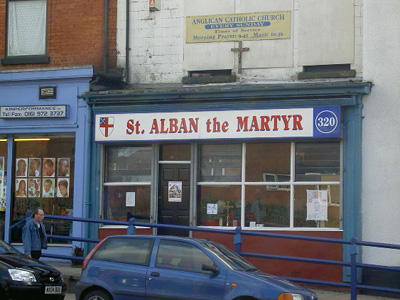
St Alban-the-Martyr


I just thought I'd share my most recent Mystery Worshipper Report, which was published today. :-)

Saturday, July 29, 2006

Absence

Hello all. I'm sorry for my recent absence from the blogosphere. You'll know by now that this happens with me occasionally. I'm still here. I've been trying to work out which Sunday we're up to but I'm not quite sure that I've got the right collect in the right-hand column. Oh well! I'm sure some kind soul will point out if I've got it wrong. The intention was to post tomorrow's collect as I didn't see much point doing last Sunday's only to change it again tonight.

I started a post about St Cuthbert of Lindisfarne weeks ago and never got round to finishing it. It remains in draft form on my blog dashboard so I'll probably do that soon.

:-)

Hilda

Many of you will remember that, last year, I introduced you to Felicity. Sadly, she died a few weeks later. Something about needing water.

Anyway, after recovering from the trauma of it all, I have decided to take the plunge and adopt a new plant. I would like for you to meet Hilda. She much prefers to be viewed from this angle, though.

I have recently moved house and wanted a rubber plant until somebody told me about Swiss Cheese plants, and I instantly fell in love with the idea. They apparently grow to be quite large so I may well post occasional photographs of Hilda as she grows up. I'm all excited again. I'm also very conscientious about watering her properly. She'll need to be re-potted soon, as well. What fun!

Friday, June 02, 2006

Saint Bertelin


Saint Bertelin, pray for us!

Almighty God, Who of thy mercy didst cause thy servant Bertelin to shine forth as a beacon of humility in the kingdom of Mercia; grant us so to venerate him that, assisted by his intercession for us in heaven, we may follow his example here upon earth, and thereby attain unto everlasting felicity. Through Jesus Christ thy Son our Lord, Who with Thee and the Holy Ghost, liveth and reigneth, God, now and ever, and unto the ages of ages. Amen.

Before England was united, it existed as a group of seven often warring kingdoms. The largest and, arguably, the most powerful, was Mercia, which covered all of what is now the North-West of England, and parts of the Midlands, and its centre was in modern-day Staffordshire. Despite previous thought, it is now widely believed that Mercia did have some form of hereditary monarchy.

Bertelin (whose name is often corrupted to Bertolin or Bertram), was an 8th-century King of Mercia who, in time, took a wife. On one occasion, while Bertelin and his now pregnant wife were on a journey through the woods, she went into labour. He rushed to seek the assistance of midwife, and returned only to find that his wife and child had been savaged by wolves and killed. Having lost what was so meaningful to his life, he gave up all of his wealth and status, and turned instead to God. He retreated to a cave and lived as a hermit, and people began to come from miles around, perhaps initially to see the spectacle of a king who had apparently taken leave of his senses but, in time, to seek his spiritual guidance.

After he died, his tomb became a place of pilgrimage, and many healing miracles were reported as having taken place after people had venerated the place. Because his shrine is located in a country church in a secluded village, by God's grace it survived the iconoclastic desecrations of the reformation era and later, those of Oliver Cromwell and his accomplices, and it is still a place of pilgrimage to this day.

His Feast is celebrated on the 10th of August, being the 23rd of August in the secular calendar.

Monday, May 22, 2006

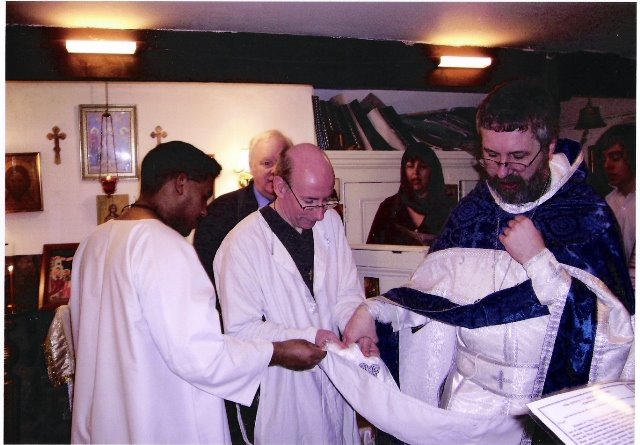
More photos

I recently received some more photographs in the post. Here they are.


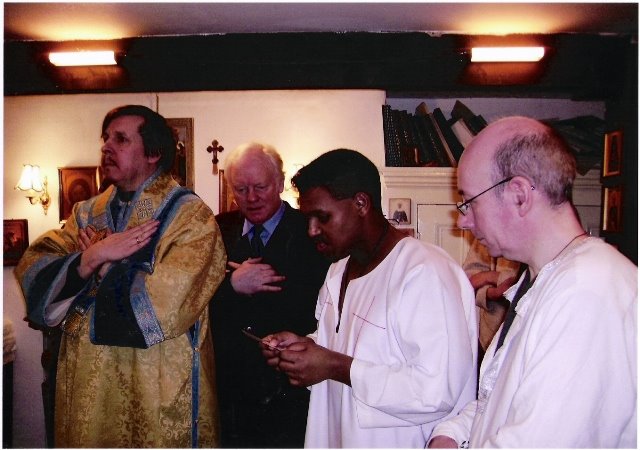
Being Churched: the perambulation


I believe, O Lord, and I confess...


My first Communion


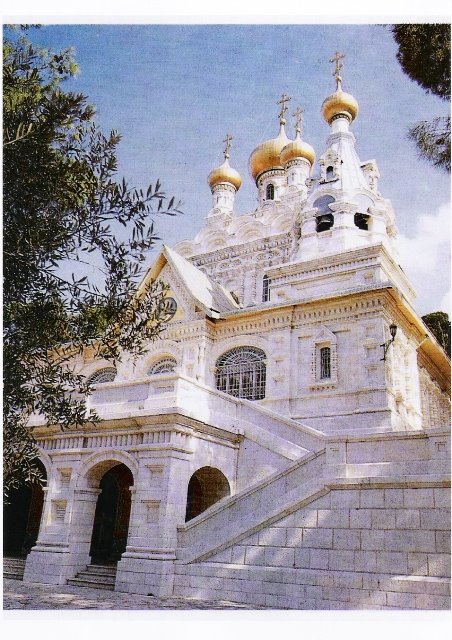
The Church of St Mary Magdalene which houses the relics of St Elisabeth the New Martyr

Thursday, May 11, 2006

Button Moon


We're off to Button Moon.
We'll follow Mister Spoon.
Button Moon! Button Moon!


I'm old. It has finally been confirmed.

I was watching Nick Jr. the other evening (as one does), and saw that a section was dedicated to children's television programmes that I enjoyed as a child. There were things like Thomas the Tank Engine, The Herbs, The Clangers and Button Moon. What worried me was that this segment was called "Nick Jr. Classics". Classics! For goodness' sake! It's as though my flab and the grey that my parish priest's daughter pointed out (very loudly), that I have in my beard don't make me feel old enough.

Still, it was damn good fun to see my childhood "classics" again, especially Button Moon. For those of you not from this isle, or for those not of my generation or without children of my generation with whom you watched, Button Moon was fantastic. It was extremely low-budget. The set was simply a backdrop of velvet - a large, black, velvet blanket with sequins stuck to it. This was supposed to be the night sky with its stars. The moon was a large button which was suspended in front of it.

There were three main characters: Mr Spoon, Mrs Spoon and Tina Teaspoon, their daughter. They were puppets made out of everyday kitchen items like bottle tops and sponges, with tiny spoons for arms. Every day, Mr Spoon, often accompanied by Tina, would fly to Button Moon in his spaceship (a baked bean tin, resting on a salmon tin, with a funnel on top). There they would encounter all manner of interesting characters: strange animals, sponges, bowls, taps, and everyday things, with personas all of their own. The puppetry was amazing. They would solve problems like the kitchen sponge's aversion to water.

At the end of each day, Mr Spoon would fly home and greet his wife, as though he'd been working hard all day, when he had, in fact, just been playing about all day.

There's more about Button Moon here and the closing theme song is here.

Whoever said that nostalgia isn't what it used to be was quite simply wrong.