As of December, 2009, this blog is inactive at this location. All posts have been transferred to the new location here. You are very welcome to read and comment.

Sunday, May 03, 2009

When Russia invaded Antioch

I had a lovely morning today. I usually travel about forty miles to get to church but, this weekend, my parish priest and his family have been staying much closer to where I live, so we all trundled along to my local Antiochian parish.


The iconostas at St Aidan's Orthodox Church, Manchester

Father Paul stood in the altar during the Liturgy but I didn't serve, standing instead with the merry bunch from Birkenhead. We all sang along with the choir and I vested at the appropriate point and received Communion. It was so lovely to be able to do that. Father Gregory and the good people at St Aidan's were welcoming hosts, as ever, and it just felt so natural for us to be there.

Only two years ago, while this would not have been impossible, it would certainly have been far less likely to have happened. I find this development very encouraging, as it is a sign that we are beginning to be more properly integrated into Orthodox life in the UK. May things continue to move in this direction.

Monasticism

I'd like to share one of my favourite passages from A Night in the Desert of the Holy Mountain. The visiting bishop tells of his feelings when celebrating the Divine Liturgy at the request of the monks.

I confess that that particular Divine Liturgy created a difficult situation for me. Never in my life had I experienced such embarrassment and at the same time such inexhaustible joy. I felt embarrassment because I was among saints. When I came out of the altar to give the blessing, saying, 'Peace be with you all', I was perplexed. 'But they have this peace, whereas I need peace', I was thinking. When I gave the apostolic blessing, 'The grace of our Lord Jesus Christ, and love of God the Father, and the communion of the Holy Spirit be with you all', I knew very well what I was doing. I was giving the blessing and grace to those who were full of grace. I was saying, 'Let us lift up our hearts' to people whose hearts were always lifted up. I was the only one concerned by that command.

...

It is an embarrassing situation to celebrate the Liturgy and impart Christ to those who are gods by grace. Christ is present there. "God among gods who have been deified by Him Who is truly God by nature."

Is this reflective of others' experience of monasticism, especially those who have been to the holy mountain? I have, in the pastm encountered a sequel to this book. However, I forget the title. Is anybody able to give an indication of whether it is as enlightening and inspiring as A Night in the Desert? If so, I would be very grateful if you were to share your thoughts. Thank you.

Saturday, May 02, 2009

Because Cats are better than Dogs

Pascha in France


Continuing the paschal theme, the above is a video from the Western Orthodox Church, depicting some excerpts from their Good Friday Liturgy and Paschal Vigil. They are a communion of three churches in France, (though with a small UK presence), comprising a number of parishes and missions, and one coenobitic monastery. In the 1930s, the Russian Church received some former Old Catholic parishes into the Orthodox Church, with a charter to continue the ancient western traditions that had been practised by the first-millennium Saints of the Orthodox west. The original Ukase from Moscow named them Western Orthodox and called for them to be fully integrated into the life of the local church.

Sadly, this integration never really took place, largely due to a lack of understanding of the Western Rite among many Orthodox Christians of the Eastern tradition - including many of the hierarchs. That community has not always been well treated and has struggled over the decades with different local churches trying to force them to relinquish their western traditions, yet through all of this they have remained faithful to their original calling to bring the light of Orthodoxy to western people, using many of the prayers and forms of worship that would have been familiar to the Orthodox Saints of the west in the first millennium. Sadly, this has meant that they are currently not in communion with any of the mainstream Orthodox churches.


St John, serving the Gallican Liturgy of St Germain

Their only real period of active encouragement and support from the wider Orthodox Church was during the 1950s and 1960s, when they were under the care of Archbishop, now Saint, John the Wonderworker. He commissioned research into the ancient Gallican rite and restored this to use, with Byzantine interpolations, for the celebration of the Divine Liturgy in the French church. He himself served this Liturgy, and even had a bishop consecrated for the church.


The Consecration of Bishop Jean-Nectaire
The first Western Orthodox Bishop for 1000 years,
glorified as a Saint by the Western Orthodox Church


Today, the French church is generally bi-ritual. Their liturgies are mainly western where usable manuscripts of these services have survived though they are sensitively supplemented with Eastern liturgical traditions. This is no innovation as the Gallican rite always had strong eastern influences, the inclusion of the Trisagion being an ancient example of this. Their music is predominantly a develoment of ancient western plainsong, but harmonised, and supplemented by some Russian Obikhod chant. This combination of the best of eastern and western traditions, restoring the ancient and using it alongside that which has been continuous in the life of Orthodoxy, is really very beautiful. For example, the use of the trikiri and dikiri, now standard practice of Orthodox bishops, would have been just as alien to St John Chrysostom as it would to St Germain of Paris. However, it is a later development that has become standard in Orthodoxy and there is no reason why a Western Rite church cannot adopt it. The Church is a living organism, after all. Also, the veneration of the Cross on Good Friday, depicted in the video above, will be recognisable to many western Christians but the more discerning will notice the similarities between the ceremonies of the Cross and shroud in that video and those surrounding the Epitaphios in the Byzantine Rite.

At the dawn of the 21st century, the French church, by this time called the Orthodox Church of France (ECOF), faced some very difficult challenges as certain revelations about its bishop came to light. This threw the church into turmoil. Three identifable groups separated from ECOF at different times. Of these, one has returned to the fullness of communion with the rest of the Orthodox Church and enjoys the care of the Church of Serbia, blessed be God! The remaining two have reunited with each other, and, having united with a third small church, have returned to their original name of the Western Orthodox Church. It is this reunited group that is depicted in the video above.

I pray for the day when they are once again returned to the fullness of life in the Church. They appear to do some good missionary work and spiritual development and their absence from our communion is a great loss to us indeed. Please join me in praying for restored communion with these churches. I leave you with a video of a diaconal ordination.

Never, never, never let anyone tell you that, in order to be Orthodox, you must also be eastern. The West was Orthodox for a thousand years, and her venerable liturgy is far older than any of her heresies.
Words of St John the Wonderworker,
spoken to Abbot Augustine (Whitfield) on the subject of opposition to the Western Rite within Orthodoxy


Pascha at Christ the Saviour, Moscow


The commentary gets a little annoying in parts but it is well worth viewing.

A Paschal Sequence

And now that the synagogue hath scorned Thee, wandering and straying in error, Thou hast made thy Church to spread abroad, in a lineage noble through all the sunlit earth. Whence I entreat Thee, by the marks of the Cross, and by the rose-red streaming of thy blood, those whom I bring forth to Thee as my children [this is all the voice of the Church] do Thou fill with grace streaming from heaven.

This is an excerpt from an Anglo-Saxon sequence from the Paschal Vigil, and was recently sent to me by Fr Aidan. I thought I'd share it as I find it really quite beautiful.

A Metropolis of Western Europe?


The reposed Patriarch Alexei

Back in 2003, the now reposed Patriarch Alexei of Moscow and All Russia addressed this open letter to some of the bishops the Russian church in Western Europe. In it he calls for a regularisation of the Russian Orthodox presence in this part of the world. At the moment, we have dioceses of the Moscow Patriarchate, the Russian Chuch Abroad, and the Paris Exarchate under the Ecumenical Patriarchate for churches of Russian tradition, all overlapping each other - not to mention two bishops of Berlin!

Much of the irregularity is the direct result of the actions and principles of the godless Soviet state but that is now in the past, and today we are left with the business of tidying up the administrative mess for the wellbeing and salvation of the Orthodox Christian people. Eventually, we need to look at the bigger picture of sorting out the canonical scandal of overlapping jurisdictions so that we can have a single, united Orthodox Church in this part of the world, whether it be in Great Britain or more widely in Western Europe. However, that will not happen until the jurisdictions sort out the internal disorganisation within their own respective structures. I think that we have become so accustomed to this situation that we often forget that it is highly irregular and we fail to realise the image that it creates in the minds of those who observe us, for such an arrangement is traditionally the result of schism and heresy. People see us and they perceive division where there is none. Although we know better, we cannot expect non-Orthodox people to have an intimate knowledge of the inner-workings of Orthodoxy on first encountering us. The onus is on us to tidy up the mess.

For my part, I welcome the Western European metropolis. I am delighted that the Russian church is now once again united in full canonical communion and hope that it can now be normalised. If this metropolis does come to be, it will incorporate the monasteries and parishes that are currently in the ROCOR dioceses of Germany, Great Britain & Ireland, and Western Europe, and the MP Diocese of Sourozh, along with their presence on the European mainland. Presumably, if the Ecumenical Patriarchate is amenable to this, those parishes and clergy of their Paris Exarchate who wished would also be welcome to join, thereby returning to the Russian church.

In the words of the Patriarch himself:

We hope that an autonomous Metropolia, uniting all the faithful of the Russian Orthodox tradition in the countries of Western Europe, will serve, at a time pleasing to God, as the foundation for the future canonical establishment of a multinational Local Orthodox Church of Western Europe, to be built in a spirit of conciliarity by all the Orthodox faithful living in those countries.

In a spirit of love I call upon you all, dear Bishops, Fathers, Brothers and Sisters, to labour in the great work of healing the painful divisions of the Russian diaspora. May the God of love and peace bless your efforts.

If this does go ahead, it will be a great step towards moving towards a single local and canonically regular Orthodox church in our part of the world. The benefits of this would be immeasurable. Firstly, it would restore canonical harmony to Orthodoxy in Western Europe for the first time in centuries. This would make more visible the loving communion that the Church is. It would better place us to pool our resources and combine our efforts at mission, restoring the ancient Orthodox Faith of Britain to its people, whose heritage it rightly is, bringing them to the fullnes of life in Christ. It would do away with the common misconception that we are fragmented and divided due to the fact that a different bishop has jurisdiction depending on which parish you happen to go to. All of these things would be nothing but good.

The ground is fertile for the beginnings of such a venture, and through prayer and faith, it is possible. The Russian church is once again at unity within itself. The proposed Russian metropolis would map almost directly onto the territory currently covered by the Antiochian Archdiocese of Western Europe, already known and respected for its missionary work. Relations between Russia and Antioch are traditionally very good, and it would be splendid if the churches could work together in this way. The Serbian and Georgian presence in that territory could later become a part of this if they so wished. And who knows? There may even be a possibility of inclusion of the unfairly much-maligned Milan Synod. The possibilities are there and, if it God's will, it can and must happen.


His Eminence, Archbishop Mark of Berlin, Germany, and Great Britain

My own bishop has spoken on this subject fairly recently, seeing it as a good thing. Speaking to Interfax in January of this year, he said:

It seems to me that sooner or later we will have to take up the problem of establishing a metropolitan district in Western Europe.

I agree with him entirely and pray for the day when this comes to fruition.

So what do we do to restore oneness of life, communion, and harmony to the Orthodox Church in this part of the world? We need to speak to our priests, speak to our bishops, and let them know that we, the faithful on the ground, desire this. We need to build friendships with our brothers and sisters in other Orthodox churches, visit their churches and get to know them. We need to support them in any missionary efforts and special occasions in the lives of their parishes, and invite them to share in ours. We need to organise pilgrimages with them to the shrines and holy places of this land, where the Saints walked, and lived, and worked out their salvation, and we need to pray, with them, to these very same Saints, asking their intercession for the blessing of the all-holy Trinity on our life and work in this country today. Eventually, we shall begin to operate at the most fundamental level as a single church and, when this is ratified in council, it will merely serve to regularise a situation that will already have existed for some time.

O Thou Who hast bestowed upon us these common and concordant prayers, and Who hast promised that when two or three are agreed in thy name Thou wouldst grant their requests: do Thou Thyself now fulfil the requests of thy servants to their profit, granting us in this present age the knowledge of thy Truth, and in that to come, life everlasting.
The prayer of the third antiphon from the Liturgy of St Basil

Crist Aras!

Christ is risen!

And with that I shall make an attempt at resuscitating this blog at the encouragement of friends, old and new. Those who did not follow my blog when it was active can be forgiven for their ill judgement. However, those who knew it should know better than to ask for it to come back. I can only imagine they like me. :-)

In any case, who I am I to disappoint? Some time has passed now so it is possible that I may have new things to say. Please feel free to join in, comment, and stimulate. I really appreciated everybody's help during my exploratory years and would love to see it continue.

In Christ,
Michael

Friday, May 01, 2009

New Orthodox Church in Wallasey


From celestial realms descending,
ready for the nuptial bed,
to his presence, decked with jewels,
by her Lord shall she be led;
all her streets and all her bulwarks
of pure gold are fashioned. - Urbs Ierusalem Beata


After years of worshipping in a converted room in a private home, my parish is hoping to move to new premises in July. We have secured a redundant cemetery chapel in Wallasey, not far from where we are now, so our people will be able to travel there. We have use of it for 25 years. The cemetery and its chapel mean a lot to the local people and already we have had positive responses from people in the area. Some have begun reading up on Orthodoxy and hope to come to some of our first services in the new church. It's all very exciting.

From our perspective, it means that we shall have a visible place of witness that is recognisable as a church, and space to meet for social functions, catechesis, and perhaps other activities, without feeling as though we are imposing on the generosity and hospitality of a family. Who knows what may come of this in time, with prayer and effort?

A great deal of work needs to be done but there will be photo updates on the parish website as things progress. You need some imagination at the moment to see what it could be but by allmeans look at the "before" photos and see what you think. Let's see how things develop.

Daily, daily, sing the praises
of the city God hath made;
in the beauteous fields of Eden
its foundation stones are laid.

O, that I had wings of angels,
here to spread and heavenward fly,
I would seek the gates of Zion,
far beyond the starry sky!

All the walls of that dear city
are of bright and burnished gold;
it is matchless in its beauty,
and its treasures are untold.

In the midst of that dear city
Christ is reigning on His seat,
and the angels swing their censers
in a ring about His feet.

From the throne a river issues,
clear as crystal, passing bright,
and it traverses the city
like a beam of silver light.

There the forests ever blossom,
like our orchards here in May;
there the gardens never wither,
but eternally are gay.

There the meadows green and dewy
shine with lilies wondrous fair;
thousand, thousand, are the colours
of the waving flowers there.

There the wind is sweetly fragrant,
and is laden with the song
of the seraphs, and the elders,
and the great redeemèd throng.

O, I would my ears were open
here to catch that happy strain!
O, I would my eyes some vision
of that Eden would attain!

Friday, December 28, 2007

The Benedictine Fellowship of St Laurence

I have just learnt of the existence of this effort. It seems a wonderful development and I pray that God may bless their work and bring it to fruition for the salvation of souls. There is more detail about the plans for a retreat house in the pdf newsletter, The Chalice, linked from the above site. It is very encouraging indeed. It would be lovely to see a monastic community be established there at some point in the future.

I also think that the setting aside of burial space is a very wise move indeed. I don't know what the situation is in the US but it is not good in England. There is no Orthodox cemetery that I know of that is under the care of anybody in communion with the Church. There was Brookwood but things are sadly as they now are and we must accept that. However, the result is that the faithful are laid to rest in blessed graves in otherwise unconsecrated ground, facing east if they happen to get a plot that allows for this. It really is quite unacceptable. We need a cemetery, consecrated to the purpose for the burial of the physical remains of those who have died, looking for the Dayspring and awaiting the Resurrection to eternal life in our Lord, the Christ.

I hope that things go well for this venture and may God bless those behind it.

Wednesday, December 26, 2007

St Elisabeth's Convent, Minsk


Remember everything I told you, my dears. Always be not only my children, but obedient disciples. Keep together and be like one soul - everything for God - and say like St John Chrysostom, as he was sent into exile: "Glory to God for all things!" - St Elisabeth the New Martyr

Some of you will know of the travelling nuns. At least one a year, two of the nuns from St Elisabeth's convent in Minsk, Belarus, travel to Great Britain in a van, and drive across the country, visiting parishes, selling their wares, and taking orders for other things. Usually Mother Maria and Sister Tatiana come to raise funds to enable to the work that the nuns do with children with special needs. Some months ago we watched a DVD at church showing some of the work that they do and it really was tear-jerking. It was actually quite funny to see nuns with painted faces and bee antennae on their heads, dancing around with the children.

Our parish commissioned an icon of our patron Saints, which arrived and was blessed last month. It is truly beautiful. The detail and colour combinations blend so well and it is clear that the nuns take to heart the words of St Elisabeth, which are remarkably similar to the Benedictine dictum ut in omnibus glorificetur Deus, (that in all things God may be glorified). The cost was also a fraction of what it would have been had we ordered something like that in the UK. While it would be good to support our local iconographers, the truth is that many people cannot afford to pay the sort of prices that are charged by people who write icons in order to earn a living. Understandably they must charge for their time and I do not criticise them at all but the nuns produce so many icons for churches and individuals that everything is readily available to them, and, because they live communally and much more simply than most of us do, the costs are kept quite low. It would be good to be able to support them and their work. If I remember, I shall take a photograph of our parish icon and post it here.

Sadly, I don't actually know how to contact them but I'm sure I can find out easily enough if anybody were to want to know.

Saint Cyprian


St Cyprian of Carthage, Bishop, Doctor of the Church, Martyr +258

When I was made a catechumen and later baptised, I was given the name Michael, which had always been my name anyway. There was never really anything in the way of discussion about the taking of another Saint's name. While we have never discussed it, I think that my parish priest may be of the school of thought that says that if one already has a Saint's name, it is right to keep that name for, after all, that Saint has guided and prayed for the person and has helped to bring him to the point of coming to Christ. I see much merit in this and it does indeed make sense to me. That said, it seem to me that, on the psychological level, a change of name is a good way of marking the beginning of a new way of life. A conversion of will, heart, mind, body, and entire being to the Way, a rebirth as a new creature from the font of Baptism, seems to naturally call for a new name. We see in Scripture the understanding that the name is tied up with the identity of a person, and we see names changed as they understand themselves and their relationship with God differently.

I should very much like to take a new name in the Church. Part of me is very glad that I didn't choose a name when I was baptised, largely because I knew very little about the plethora of Saints that there are, and would have likely chosen the name of Bertram/Bertelin, after the local Saint whose tomb I visited on the day before my Baptism. However, in honesty, while I have a great privilege in being able to make pilgrimage to his holy places, and while I am moved by the humility displayed I his life, I haven't really developed a devotion to him in the way that I have St Winefride or St Cyprian, both of whom I knew little to nothing before I came to Orthodoxy and began to learn much more about the Saints.

I really do feel an affinity to St Cyprian, for the clarity of his teachings, the pastoral sensitivity in working out the practical application of them as they apply to real people, and mostly for the nature of his teachings. As some will know, my initial reasons for being spurred to explore Orthodoxy were to do with ecclesiology. That has acted as a springboard for the rest of my love and understanding of our holy Tradition, and I find that love and understanding affirmed and expanded by the writings of St Cyprian. The Church as a communion of God's children, bound together by common faith and love for God and one another, in celebration of God's love for us, and with the destiny of moving into oneness of life with the Trinity really is quite beautiful. While much of what is found in St Cyprian's treatises and epistles may not be very popular among many people today, his writings are held up as a clear expression of Christian understanding on the matters on which he wrote, and he himself was martyred for confessing that Christian Faith. He really serves as a great inspiration to me and it would be lovely to be able to take his name. However, I have been baptised with the name Michael and that is what my name is in the Church. There must be some sense in this, but it is unclear to me at the present why the delay in my knowing much about the Saints is simultaneously the opportunity for me to find in whom I find one in whim I find strength and inspiration and also the reason why it is too late to take his name.

Perhaps this is one of those occasions where I need to allow my own will to be moulded by God's, even though I don't quite understand.

Monday, December 24, 2007

Friendships


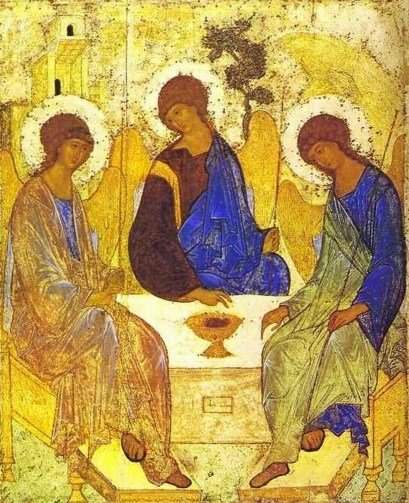
The Old Testament Trinity, St Andrei Rublev

It's one thing to understand on the academic level that mankind is called to grow into the communion and life of the Trinity but it's another thing entirely to see the effects of this in our day-to-day relationships.

Within the past month or so, I have, by God's grace, experienced the peace and happiness that have come with family relationships that are improving for the first time since the late unpleasantness. The need of man to be at one with his fellow human beings in a relationship of love is one that really cannot be denied. It just feels right, and it is the state in which we find ourselves at our happiest. At no time is this more evident than when relationships suffer or, worse yet, come to an end entirely. I have also had a friendship come to a very painful (but practically necessary) end, and although there has been no animosity involved, I feel so empty, as though an essential part of me has been removed. It's a similar feeling to that experienced when somebody dies.

I'm not wailing or lamenting, but rather just sharing my musings. It is one of those
occasions - you'll all know the ones I mean - where I have suddenly come to an awareness of real life and doctrine meeting, and it just struck me as noteworthy. I suppose I've nothing much more interesting than that to say.

Do have a holy celebration of the Nativity of the Lord God, those of you who are celebrating today.

The Monastic Diurnal Group

I was pleased to recently discover the new and much-improved group, now hosted by Google. There is a good collection of articles on the Benedictine way of life and resources for the Divine Office. While it assumes use of the Revised Julian calendar, much of it is still invaluable to those of us on the Julian calendar. I'm grateful to Subdeacon Benjamin and others for their work and thought I'd post here just in case there were any others who, like me, came late to an awareness of this.

Saturday, August 18, 2007

The Transfiguration of Our Lord


We look for the Saviour, the Lord Jesus Christ, Who shall change the body of our humiliation, that it may be conformed to the body of his glory. - Philippians 3:20-21

All ye who seek for Jesus, raise
your eyes above, and upward gaze:
there may ye see the wondrous sign
of never-ending glory shine.

Behold Him in celestial rays
Who never knoweth end of days;
exalted, infinite, sublime;
older than heav'n or hell or time.

This is the Gentiles' King and Lord;
the Prince by Judah's race adored,
promised to Abraham of yore
and to his seed for evermore.

To Him the prophets testify;
and that same witness from on high,
the Father seals by his decree:
'Hear and believe my Son', saith He.

All glory, Lord, to Thee we pay,
Transfigured on the mount to-day;
all glory as is ever meet,
to Father and to Paraclete. Amen.
Quicumque Christum - The Office Hymn at Vespers

I love the Feast of the Transfiguration, and shall be celebrating it tomorrow at the Parish of the Intercession of the Mother of God here in Manchester.

I'm ashamed to say that it was only last year that I began to properly understand the significance of the Feast, and yet I'm delighted that I now do. It had always been for me the cause of some confusion. Yes, Our Lord appeared in brilliance and two long-deceased key figures in the history of the people of Israel appeared along with Him, but what was the point of it all.

It is, of course, Christ's showing to us that He is the fulfilment of all things, and giving us a taste of the pure Light that is God, in which we are called to share, and which is the purpose of our journey of theosis/deification, and the whole point of our life and existence. Moses and Elijah's presence show Christ as the summit of both the Law and the Prophets, not called to replace them but to show their meaning in the splendour of their fullness in Him.

The disciples, who are with Christ, not having yet completed their theosis, are unable to look upon Him transfigured for they do not yet share in that brilliance, holiness, and life of the Trinity. I love the way the Transfiguration icons show them in various states of disarray, averting their eyes, tumbling down the mountain, falling to the ground. For them to behold that Presence would be destructive to them. We see the same thing in the Old Testament where contact with holiness means sure and certain death. Uzziah reaches out to prevent the Ark of the Covenant from falling and dies instantly because he lived before the Incarnation and Ascension, before the New Covenant, where completion of theosis was quite simply impossible. Only those in the Old Covenant who had met with God's favour were able to approach Him, and even then it was in veiled form, as a burning bush, or a voice from a cloud. Even then, for them to have been exposed to the fullness of the splendour of God would have been pain beyond what they could bear. This is hell - the brilliant Presence of God as experienced by those who have not accepted his grace to conform their hearts, minds, bodies, wills, and their entire being to Him. This bizarre concept that hell is somehow the absence of God is just too far removed from God's revelation of Himself to us and indeed from the belief and practice of the Church to be taken seriously.

O heavenly King, Comforter, the Spirit of Truth, Who art everywhere present and fillest all things; Treasury of blessings and Giver of life, come and abide in us, cleanse us from all impurity, and save our souls, O Good One!
- from the Trisagion Prayers

Whither shall I go from thy Spirit?

And from thy Presence whither shall I flee?
If I go up to heaven, Thou art there;
if I go down into hades, Thou art present there.
If I take up my wings toward the dawn
and make mine abode in the uttermost parts of the sea,
even there shall thy hand hold me.
- verses from Psalm 138

How can there be a place where God is not? Yes, hell is a separation from God but only in the sense of self-imposed rejection of unity and communion with Him, causing his Presence to be experienced as unbearable agony.

Yet with our the restoration of our human nature to the heavenly state at Christ's Ascension was the gate once again opened for us to follow, including all those who had died before the coming of Christ who, at his glorious Resurrection, pulled them from the jaws of death and Hades where they had been waiting.

Let no one fear death, for the Saviour's death has set us free.
He that was held by it extinguished it.
Having descended into Hades, He made Hades captive.
He embittered it when it tasted of his flesh.
And Isaiah, receiving this beforehand, cried out:
'Hades,' said he, 'was embittered when it met Thee in the lower regions.'
It was embittered, for it was destroyed.
It was embittered, for it was mocked.
It was embittered, for it was slain.
It was embittered, for it was cast down.
It was embittered, for it was bound.
It received a body, and met God face to face.
It received earth, and encountered heaven.
It received that which was seen, and fell upon that which was unseen.
O death, where is thy sting? O Hades, where is thy victory?
Christ is risen! and thou art cast down.
Christ is risen! and the Angels rejoice.
Christ is risen! and life lives.
Christ is risen! and not one of the dead remains in the grave.
- from the Paschal catechetical sermon of St John Chrysostom.

So in the Transfiguration, we have a foretaste of our calling, made possible by Christ's taking upon Himself our human nature, descending to our death and conquering it by his glorious Resurrection, and taking that human nature once more into the Presence of God. It is this destiny of ours that in which the Saints already share, and of whom Our Lady is chief, whose glorious Assumption we celebrate in a few days' time. May they pray for us.

A blessed Feast of the Transfiguration to all celebrating at this time.

O God, Who in the glorious Transfiguration of thine Only-Begotten Son didst confirm the mysteries of the Faith by the testimony of the fathers, and in the voice which came down from the bright cloud didst marvellously foreshow the perfect adoption of sons: vouchsafe in thy mercy to make us coheirs with the glorious King, and grant that we may be partakers of his glory. Through the same Jesus Christ thy Son our Lord, Who with Thee and the Holy Spirit, liveth and reigneth, God, world without end. Amen.