As of December, 2009, this blog is inactive at this location. All posts have been transferred to the new location here. You are very welcome to read and comment.

Wednesday, May 10, 2006

Concerns about the Western Rite

Something Joe said in a comment on the Britannic Orthodox Church? post got me to thinking.

I have heard a number of objections to the Western Rite from various quarters. Some have been from people from traditionally Orthodox countries where the way they phrase their objections has betrayed an ignorance of the history of Orthodoxy outside of their home countries. Others have been from a reactionary "East good: West bad" mentality that seems to exist among some Orthodox groups, where the Divine Liturgy of St John Chrysostom is viewed as having fallen out of Our Lord's back pocket at the Ascension.

However, other concerns raised about the WRite have been more reasoned than this, and do have some merit. I think that Joe's sentiment falls into this category.

It's either a stilted piece of archeology or a byzantinized form of Anglican or RC praxis. At least that's it in simple terms.

Before I continue, I must admit now that I don't have any direct experience of worshipping within the WRite in an Orthodox context, and so my knowledge comes mainly from discussing with those who do and from examining the rites myself, and discussing with those who have had a part in adapting them.

I'll take the first objection first. The restoration of the WRite is not intended to be an exercise in liturgical archaeology. That would be a grave mistake. Liturgy isn't just about words and ceremonial, but about the Faith, spirituality and piety that these rites sustain and are sustained by. The liturgy is only a part of the greater whole and develops and grows naturally within that context. I, too, would be wary of any effort at re-creating the Use of, say, York, as it was 500 years ago, for use in Orthodoxy today. I must admit that I love these forms of worship, but this is an idiosyncrasy of mine. Even while I was salivating over the text of the Old Sarum Rite Mass, translated and superbly produced by Monk Aidan (Keller), (whose excellent Chant Ordinarium I have), part of me was uncomfortable as I realised that it is something that, sadly, would not be of practical use today. That's the reality of the situation and, while there are a few of us who would be very comfortable in our worship if the Rite of Sarum were in common use, we need to realise that we are a very small minority. It's worth noting, too, (with respect to Monk Aidan, whom I know reads this blog), that no canonical Orthodox jurisdiction has authorised this for use, perhaps for the reasons mentioned above.

Within canonical Orthodoxy, a more organic approach has been taken to this. Instead of resurrecting rites long deceased within the Church, the approach has been to draw into Orthodoxy the liturgucal traditions that are currently used by Western Christians, which have developed and grown as living rites within a community of faith; rites which take one of two main formats: those with their roots in the Anglican Book of Common Prayer and the majority which follow the classical shape of the ancient Gregorian Mass. Of course, the doctrinal defects in these rites have needed to be corrected to restore their suitability for use within Orthodoxy. This has involved changes to the glaringly obvious differences (such as the removal of filioque), and more subtle changes (such as the restoration of the sung propers which largely fell into disuse after the liturgical actions they were intended to cover were either reduced or removed entirely because of protestant objections to them).

RCs, Anglicans, Methodists and others will be familiar with the classical Gregorian shape of the Eucharist, even if they are unaware of the fact. The Novus Ordo Mass and rites based on it (such as the Methodist Worship Book and Common Worship order one) are all developments of this to one degree or another, and while not suitable for Orthodox worship themselves (for other reasons), mean that this is the basic shape that many Western Christians are familiar with, and have been for centuries. Therefore, an updated form of Sarum would be appropriate, IMO, as would the Gregorian Liturgy itself, as it has lived on to some degree in the Tridentine Mass, still used by some RCs today, and by Canterbury & Continuum Anglicans of the English Missal tradition. In fact, the Scottish Episcopal Eucharstic liturgy of 1972 (still in use) allows for a celebration very much along the lines of the Gregorian Mass, with a few canonically-permitted adaptations, and from first-hand experience, I can vouch that it is so used in some Anglican churches in Scotland.

With regard to the byzantinisations that may have crept in during the process of correcting the doctrinal forms, I suppose this all depends on one's experience of the Western rite. With regard to the rites used in the Antiochian Western Rite Vicariate, I can't comment much due to having limited experience of them. I'm sure there are others better-placed to comment on those. My knowledge is based on the liturgies of the Russian Church Abroad, where one would be very hard-pressed indeed to find any Byzantine forms. The two main ones are the English Liturgy and the Usus Cascadae.

The thing we need to remember is that the Western Rite has its roots in Orthodoxy, and, despite having been outside of Orthodoxy for centuries until 100 or so years ago, is still proving itself to be a valuable part of the Orthodox tradition by the number of people that are brought, by their spiritual formation in the Western Rite, to the point of knocking on Orthodoxy's door and asking to be let in. For the sake of the salvation of souls, I do feel that we need to open this door up much, much more widely.

Just a few thoughts.

Sunday, May 07, 2006

Cabinet re-shuffle

After Mr Blair's tidy-up, I thought I'd do the same with my weblog after a time of silence.

Regulars will notice that I have re-arranged the links in the column at the right-hand side, pruning some that I rarely use and adding many new ones. There is now an entire section on the Western Rite, which is reflective of the new purpose.

Before February of 2005, I had made a few attempts to keep a blog, all of which failed as I had gone about it the wrong way. I wanted to enter the blogosphere but didn't actually have anything to blog about. Then I began to seriously explore Orthodoxy, and sat down one day to put my thoughts together, taking up 6 pages of A4. After having been made reasonably presentable, this became my first blog post here, and I am ever so grateful for the help, support, guidance and laughs that so many people have brought to me here on my journey into Orthodoxy.

Now that stage of the journey has come to an end and a new one has begun - one in which I must settle into and grow in the Orthodox Faith and life, which will be perhaps a more private affair than my initil searching had been. Still, I don't want to lose my blog, and so I think I'll perhaps see how things go if I dedicate it from now on to another issue close to my heart, which is the missionary work of Orthodoxy in the West, more specifically in the British Isles, and the place that the Western Rite has within that. There are, of course, other blogs and sites which do a marvellous job of focusing on this, so I may be redundant here.

Let's see how things go.

Britannic Orthodox Church?


O God, the Father of heaven, have mercy upon us.
O God the Son, Redeemer of the world, have mercy upon us.
O God the Holy Ghost, the Paraclete, have mercy upon us.
O Holy Trinity, Three Persons yet One God, have mercy upon us.
Holy Mary, pray for us.
Holy Mother of God, pray for us.
Holy Virgin of Virgins, pray for us.
Holy Archangel Michael, pray for us.
Holy Archangel Gabriel, pray for us.
Holy Archangel Raphael, pray for us.
All ye holy Angels and Archangels, pray for us.
All ye Holy Orders of Blessed Spirits, pray for us.
Saint Dyfan, pray for us.
Saint Ninian, pray for us.
Saint Patrick, pray for us.
Saint Cuthbert, pray for us.
Saint David, pray for us.
Saint Chad, pray for us.
Saint Petroc, pray for us.
Saint Columba, pray for us.
Saint Alban, pray for us.
Saint Aidan, pray for us.
Saint George, pray for us.
Saint Andrew, pray for us.
Saint David, pray for us.
Saint Edmund, pray for us.
Saint Edward Confessor, pray for us.
Saint Edward Martyr, pray for us.
Saint Bertelin, pray for us.
Saint Werburgh, pray for us.
Saint Milburgh, pray for us.
Saint Hilda, pray for us.
All ye Holy Saints of God, pray for us.
O Lamb of God, that takest away the sin of the world:
have mercy upon us.
O Lamb of God, that takest away the sin of the world:
have mercy upon us.
O Lamb of God, that takest away the sin of the world:
have mercy upon us.


Almighty everlasting God, Who hast revealed thy glory to all nations in Christ; preserve, we beseech Thee, the works of thine own mercy, that thy Church which is spread throughout the world may persevere with steadfast faith in the confession on Thy Name; through Jesus Christ our Lord. Amen.

I would love to see an autocephalous, or at least, autonomous, Orthodox Church of Britain. My vision for this would be a jurisdiction in Great Britain, perhaps also encompassing Eire and the Isle of Man. It would be formed of communities from all of the major jurisdictions which currently have a presence here, and, as is right and fitting for the Orthodox Church in western lands, would be primarily Western Rite, with a sobor of mainly "home-grown" bishops who are able to serve the Western Rite, but with liturgical and spiritual provision being made for those from ERite backgrounds. It would be culturally a church of the British Isles, holding to the traditional Church calendar, and the fulness of Orthodox Faith, and would have a strong missionary, indeed Apostolic, ethos, which would be strnegthened by the unity of the Orthodox presence in this part of the world.

So am I away with the fairies or is this actually possible?

Well, at the moment, the jurisdictions with a presence here are:
-The Patriarchate of Moscow (MP)
-The Oecumenical Patriarchate (OP)
-The Patriarchate of Antioch (AP)
-The Russian Church Abroad (ROCOR)

Assuming that the canonical relationship between ROCOR and the MP is regularised, and ROCOR is granted autocephalous status, the jurisdictional situation is likely to be as follows.

The MP
- In full communion with OP, AP & ROCOR.
- Old Calendar
- WRite authorised.

The OP
- In full communion with MP & AP.
- In impaired communion with ROCOR.
- Will not recognise autocephaly of ROCOR as status not granted by OP.
- New Calendar.
- Im unsure of its approach to the WRite.

The AP
- In full communion with MP & OP.
- In impaired communion with ROCOR.
- New Calendar.
- WRite authorised.

ROCOR
- In full communion with MP.
- In impaired communion with OP & AP.
- Old Calendar.
- WRite authorised.

Presumably, those who use the new calendar would not have a doctrinal objection to switching to the old calendar, so that obstacle shouldn't be insurmountable. So it seems to me that any possibility of unity would be approaches to the ecumenist heresy and how to relate to the non-Orthodox, and canonical recognition by the Oecumenical Patriarchate. It would hardly be ideal to form an autocephalous church which is not actually recognised as autocephalous by many but itself, with a plethora of jursidictions operating in its territory, which, as I understand it, is the case in the USA with OCA.

I'm sure that there are other issues which would come into play. Perhaps others could share their thoughts here.

I'm also aware that I have ignored the presence of the so-called "Celtic Orthodox Church" and the ROCiE presence here. I don't know what the chances would be of the former being regularised as part of a Britannic Orthodox Church but I do know that any attempts at such a venture with the latter would be an exercise in futility.

IV All-Diaspora Council again

Almighty and everlasting God, Who with thy finger writest in the hearts of believers the righteousness of thy law; give unto us the increase of faith, hope and charity; and, that we may obtain that which Thou dost promise, make us to love that which Thou dost command. Through Jesus Christ Thy Son our Lord, Who with Thee and the Holy Ghost, liveth and reigneth God, now and ever, and unto the ages of ages. Amen.

The Council, the website of which is linked to above, began yesterday. Please pray for the guidance of the Holy Spirit, that it may be fruitful and the will of God be revealed.

Sunday, April 02, 2006

Baptism & Chrismation

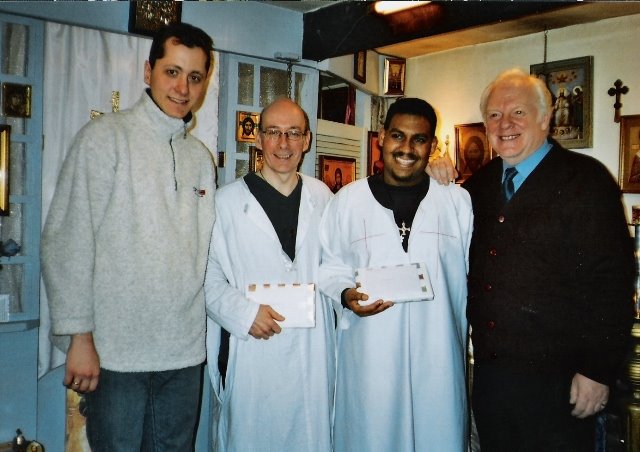
Here are some photos from the day of my baptism back in February. They weren't taken on a digital camera and so I have had to scan them. Apologies for the poor quality. You can still make out the frost on the grass, which should give you some idea of the temperature. Some water was added to the font from St Bertelin's well where I had been on pilgrimage the day before, along with some water from the River Jordan that our nuns in the Holy Land send us every year.


Waiting for the neophytes


Censing the font


The first anointing


My flab


The Baptism (2nd dip, I believe)


Indoors and dry
(three of my friends in the background)


The Chrismation


Smiles with Fr Paul


...and with the godfathers

St Bertelin's Shrine

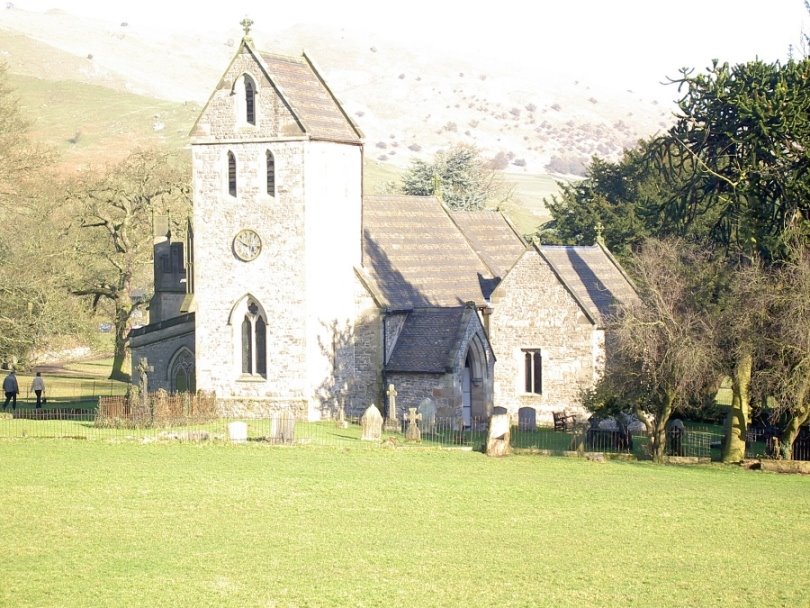
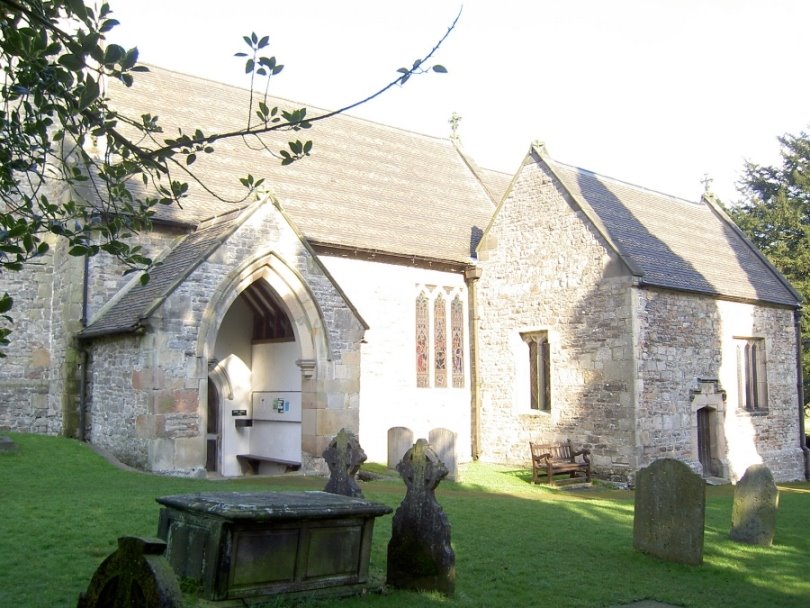
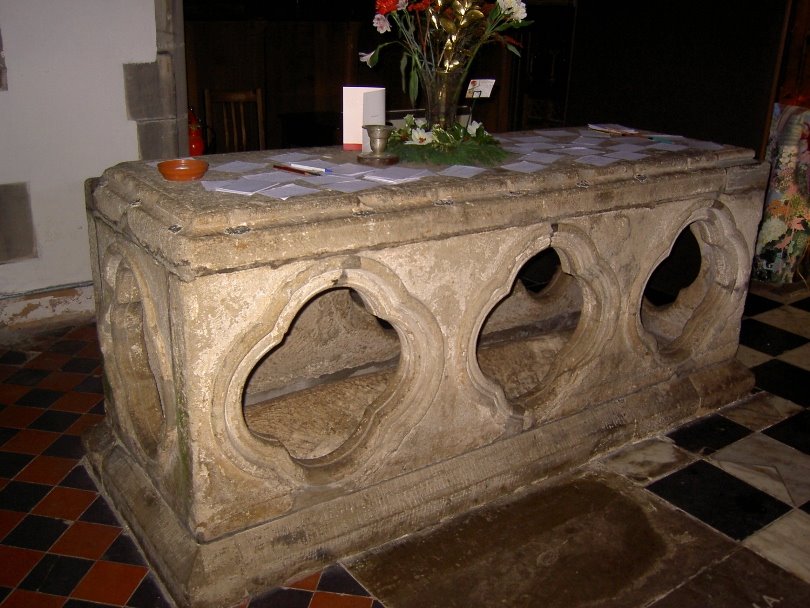
At long last, from the day before my baptism, here are some photos from my pilgrimage to St Bertelin's Shrine in the Church of the Holy Cross, Ilam, Staffordshire. There is a spring nearby, from which I fetched some water to add to the font the following day. I foolishly failed to photograph the well. Still, enjoy!


The Church of the Holy Cross


and again


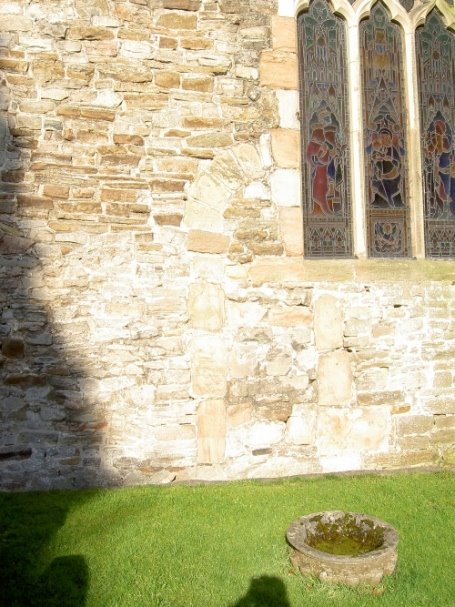
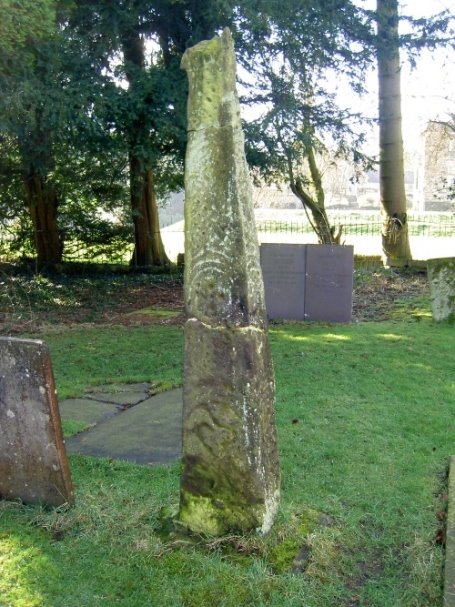
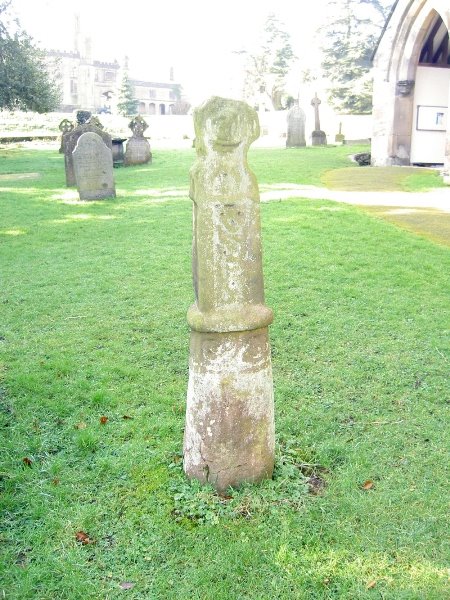
An sealed Anglo-Saxon doorway


The belfry


The base of an Anglo-Saxon Cross


and another


The Chancel


The Shrine

Friday, March 24, 2006

The Green Bottle family vs Mr Wall


Mr Wall has been charged with knowingly and wilfully inflicting grievous bodily harm on all ten members of the Green Bottle family (pictured above, after major reconstructive surgery).

A number of incidents had been reported in the vicinity of Mr Wall's residence, but suspicion only really began to be aroused when neighbours heard local children singing a song about the incidents, and began to wonder what the actual chances were of all ten bottles accidentally falling off the wall.

In an official police statement, it was revealed that this is not the first time that Mr Wall has been investigated for such offences. Some years ago, there was a major incident in which the Armed Forces got involved, as the situation got quite out of hand. The victim of the earlier attack is the key prosecution witness, and any conviction rests on his testimony. In an interview with Sarisburium News, Mr Humpty Dumpty, who was clearly still very traumatised by his ordeal, could only bring himself to say, 'I hope justice is done here. Life has been very difficult for me over the past few years', before he fell to pieces.

The case for the defence is based on diminished responsibility, as the injuries incurred by the Green Bottle family were the responsibility of the person or persons who placed them on Mr Wall in the first place. The main thrust of the argument is that this was a silly place to put ten green bottles, and was an invasion of Mr Wall's personal space. 'I could just about cope with the two little dickie birds coming and going all day long', said Mr wall, in an exclusive interview, 'but when they started with those bottles, well, what could I do? It all got a bit much.' The defence is expected to argue that, after the first few bottles had fallen, the sensible and responsible thing to do would have been to move the rest of them to a safer environment. Instead, the party responsible for their wellbeing (whom, Sarisburium News understands, considers himself to be something of a poet), used the time to compose a song about the events to teach local children.

The sole defence witness is a character witness, Mr Wall's former work colleague, Mirror Mirror, who is known for her veracity. She is expected to testify to Mr Wall's upright and supportive nature.

Please stay tuned for reports on the progress of the case as events unfold.

Thursday, March 23, 2006

O happy fault? O necessary sin of Adam?


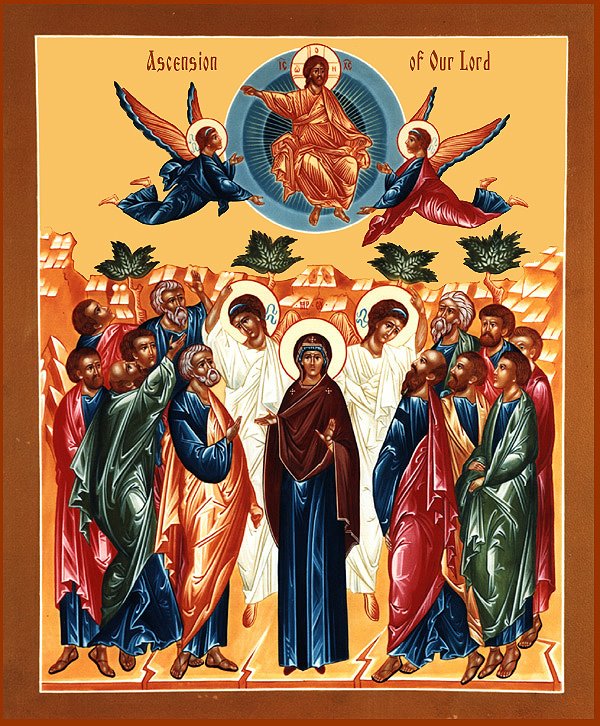
The Ascension of the Lord

Thou hast raised our human nature
on the clouds to God's right hand;
there we sit in heavenly places,
there with Thee in glory stand:
Jesus reigns, adored by angels;
man with God is on the throne;
mighty Lord, in thine ascension
we by grace behold our own.

This is something that I wrote in response to a question about Christ as mediator:

Sin or no sin, the Incarnation (God becoming human) and some form of subsequent Ascension (God's taking humanity unto God) would have happened. The Incarnation was a complete act of love on God's part and not a quick-fix because we sinned.

What we did in the Fall was to alter the human nature that God was going to adopt. We introduced death into the equation, and so the humanity that God was to become one with now included this added dimension, which itself had to be overcome and conquered. Therefore, if God were to take our human nature upon himself in order to take it into the divine nature, then death was included in this, and so he shared in it in his Crucifixion and conquered it in his glorious Resurrection, and only then did he ascend, opening the way for us to follow.

-----------

My question is how does, (if at all it does), this fit in with that line from the Exultet, which reads, "O happy fault! O necessary sin of Adam, which has won for us so great a redeemer"? If the redemption of man and creation through the Christ-event was part of God's plan for our deiication from the start (which, I believe, is a perfectly acceptable belief within orthodoxy and one with which I have much sympathy), then it was not necessitated by man's sin. If so, then does the line from the Exultet hold true? Do we use this in the text of the Vigil in the Western Rite of Orthodoxy?

I'm just a little confuddled and would be appreciative of any light that anybody might be able to shed on this. Many thanks.

Tuesday, March 21, 2006

East Good: West Bad! - In defence of the Western Rite

Below is something I posted in response to the comments of a seemingly ignorant priest on another website. I don't think I would have been quite as bothered by what he said if it weren't for the fact that he proffered no reasoning whatsoever for his dismissal of the WRite, and it just seemed to be born out of fear of the unknown, or the idea often come across in some Orthodox circles that anything west of Byzantium is of the devil.

I doubt of the "western Orthodoxy" and its "western Rites" they are really a great fall for who practice it and this is demonstrated by its serial failures.

Most of those rites are not the true rites that existed before the Great Schism in West but a medley of all kinds of things that they didn't keep any tradition with respect to Western Church previous to the Great Schism.

I doubt of the orthodoxy of these "western orthodox"

With the greatest of respect due another person and a priest, Father, I must disagree with both your sentiment and the (I assume unintentional) misrepresentation of the rites.

You would have been correct if you had said that none of the rites currently in use within WRite Orthodoxy are identical to the rites which existed in the pre-Schism Orthodox West. That is because this was never the intention, but I cannot agree with your statement that they don't keep any tradition of the Western Church prior to the Great Schism.

The point of the WRite is to restore the Orthodox Faith to the peoples of the western world using a litugical form that is accessible to them and faithful to Western Orthodox tradition. It is not about liturgical archaeology - resurrecting rites that died from use 1000 years ago. All liturgy develops and evolves. This has been the case with the ERite as well. The Liturgy of St John Chrysostom as served today is not the same as it would have been 500, 1000 years ago, and that is a living tradition.

What we have in the West today is many different Christian groups who have their liturgical and spiritual roots in developments on the classical Western liturgical shape that has its origins in Orthodoxy. We cannot resurrect the old pre-Schim rites because they are dead rites. They are not part of a living tradition with their own living spirituality and traditions as practised by the faithful. However, many, many elements of these traditions live on. For example, the Anglican Book of Common Prayer has its roots in the Sarum Rite, which is itself a development of the Liturgy of St John the Divine, which was the liturgy used in much of Britain before the Schism. Even this Liturgy of St John the Divine was done differently in various times and places. Different dioceses in England each had their own traditions, and practices, which were different from each other and from those on the continent. In Rome, the Tidentine Rite was used, which is another organic development of the pre-Schism Orthodox Liturgy. Yet all were Orthodox and all were united in the Faith of the Apostles.

What the WRite is doing today, is taking the surviving elements of those traditions - the ones which have remained practised as part of a living faith, and are perfectly consonant with the Orthodox Faith, and using them in the context of rites which are genuine developments of those which were used in the pre-Schism West.

How many Anglicans and Roman Catholics have I heard say that they would like to explore Orthodoxy further, if only it didn't seem so foreign to them, if only the esoteric liturgy were not so far removed from anything they know of Christianity?

I think the ERite is beautiful, but it does not speak to the British psyche in the same way that the WRite does, and if this is an unnecessary barrier to people coming home to the Faith, then there is no reason why we cannot use Orthodox Western Rites.

Rites like the Divine Liturgy of Sarum, the English Liturgy and the Divine Liturgy of St Gregory are all organic developments of the pre-Schism Liturgy of the West, which developed naturally over time, with their own traditions and piety. All we have done is to correct the very few doctrinal errors that had accrued over time.

(I must say that I have reservations about the Liturgy of St Tikhon, because it isn't an organic development but rather a piecemeal mix'n'match of rites with no traditions of its own. It is a valid Liturgy of the Church and so I would have no problem going to such a Liturgy but I wouldn't encourage its use. However, the others are true developments as the Liturgy grew in different places).

I'm back!

Hello everyone.

I haven't a clue what happened, but my blog has been out of action for a few days. It seems that we're working again, so let's hope for the best.

I just thought I'd let you all know that I haven't died.

Thursday, March 16, 2006

My Parish Website

Tuesday, March 14, 2006

Life Together


The Jewitt Family

Please welcome the Jewitt family to the blogosphere and pray for them during their catechumenate.

I stumbled across them completely by accident and started invading their blog with my inane ramblings, so I thought the least I could do was ask my ever-appreciated readers to join me in prayer for them.

Christ in our midst!

Fourth All-Diaspora Council

O Master all-good, watch over Thy flock and all the children of the Russian Church Abroad, that we may bring about the structuring of our Church in a manner well-pleasing to Thee. Grant us the spirit of wisdom and understanding; instill in our hearts the spirit of the fear of God, the spirit of piety and zeal for the glory of Thy holy name. Guard us against all temptations, stumbling-blocks and divisions, that, bound together, one to another, by the bond of love for Thee, our Master, we may without hindrance perform the work of our ministry for the edification of the Holy Church as the one Body of Christ. We pray Thee, O greatly Merciful One: hearken and have mercy!

O good Shepherd, Who hast promised to gather Thy scattered sheep into a single flock, put down scandal and division within the Church; all who have strayed from Thy path do Thou lead to repentance and a knowledge of the Truth, and return them to Thy fold; and confirm us all in the Orthodox Faith and the doing of Thy commandments. We pray Thee: hearken and have mercy!

These are the two petitions which the Synod of Bishops of the Russian Orthodox Church Abroad have stipulated are to be included in the Augmented Litany of the Divine Liturgy until the All-Diaspora Conference to be convened this May.

This will only be the fourth such conference since the beginning of the late unpleasantness in 1917. The main topic of discussion will be the question of restoration of communion with the Patriarchate of Moscow. The Church Abroad only ever considered itself to be the free part of the Russian Orthodox Church and not an autocephalous jurisdiction in its own right. Its formation was an accident of history, but its continuation was made necessary by incidents in Russia and later, specifically within the Moscow Patriarchate. However, political situations have changed and the Church in Russia is free once more. There are still issues to be worked through, and the Church in Russia is still finding it difficult to regain the trust of many in the Church Abroad.

Please pray for the working of God's will in this situation and for the long-awaited unity of the Church of Christ.

Sacred Scripture


This is an I want post. I don't have enough I want moments in my life, so I'm allowing myself one now.

I want an Orthodox Bible. I want One that has all of the canonical books. I don't want to have to make do with one that confines parts of the Old Testament to one corner under the false and misleading title of "Apocrypha", which is properly reserved for those books that are actually apocryphal.

However, I need some advice.

I have heard of The Orthodox Study Bible, and believe that the New Testament and Psalms have been published together in one volume, with the Old Testament planned to become available at Pascha next year or thereabouts. Apparently, it has all manner of supplementary articles, explaining how various passages of Scripture have formed Orthodox theology and spirituality over the centuries.

I was all very excited about this until I read that the Old Testament has been produced by comparing the Old Testament of the New King James Version to the Septuagint, and correcting the former as necessary, where it differs from the text of the LXX.

I have no problem with the method. However, I do have a problem with the NKJV. The language is awful, and is such that I find myself unable to read it because I'm having to try too hard to read it. It simply removes some of the more archaic forms of English from the KJV, but doesn't actually go all the way in providing a contemporary language edition. The result is that is is neither traditional nor modern, but some bizarre hybrid of the two, which is sufficiently similar to the KJV to make one think that one knows the passage, but sufficiently different to grate when one comes across a difference. If I recall correctly, it is also riddled with modern-day Americanisms, which, while perfectly fine in their own context, do sound a bit odd when mixed with English archaisms as they are in the NKJV. I just find it a very poor rendering overall, and will only buy it if there's nothing better to be had.

The second Bible I'm considering has also been published in New Testament only so far, and may be viewed here. It is a translation produced by the Holy Apostles Convent in Colorado, and comes with commentaries from the Fathers and a whole host of icons. I'm aware of the Old Calendarist, "Genuine" Orthodox source, but this isn't a problem for me. The only issue I have is that I don't know how it was produced and what the language is like, as there are no samples on the site. Also, I've only heard via a third party that there are plans to produce an Old Testament. Does anybody know more about this?

Finally, there is the Holy Orthodox Bible (pictured above), which is the labour of love of Mr Peter Papoutsis. This looks good and, judging from the samples provided on the website, the language seems perfectly acceptable. My only concern with this is the same as my concern would be with any text translated by one person, and that is that pre-conceptions and inaccuracies go unchecked. I would be quite happy with this translation if it weren't for the fact that only the Pentateuch has been produced thus far, and there is no indication of a timescale for the rest of it.

What are people's thoughts and comments? I would certainly be pleased to hear of any experiences with these Bibles, and indeed, for any other suggestions.

The Orthodox Faith

Above is a link to a set of books I was given as a Baptism present. I think it is perhaps the best short summary of Orthodox belief and praxis that I have come across so far. Fr Thomas Hopko has done a sterling job, and this really does rate highly as catechisms go.

It is much more in-depth than the Q&A Catechism of St Philaret of Moscow, which tends to just answer questions with one-liners, without much of an explanation of the answer.

I have completed the 1st volume on doctrine, and I find it to be very detailed and yet concise. I especially appreciate the section on the Oecumenical Councils, in which he places each in the context of the questions that it sought to address, and then gives detail about what was pronounced and what this means in terms of our beliefs. It really is simple and straightforward without being patronising.

I have nearly finished the second volume on worship, and think that it is marvellous. The detail he gives about the liturgical year is extremely helpful, and brings home the treasure that we have in the Church year - the sanctification of time, where we are constantly called on and challenged to focus on the great mysteries of our Faith.

I can't wait to read the rest, and would recommend this, without reserve, to anybody who is seeking to learn more about the Orthodox Faith, or even who wants a reference book to answer some of the more basic questions.

A wonderful catechetical tool!